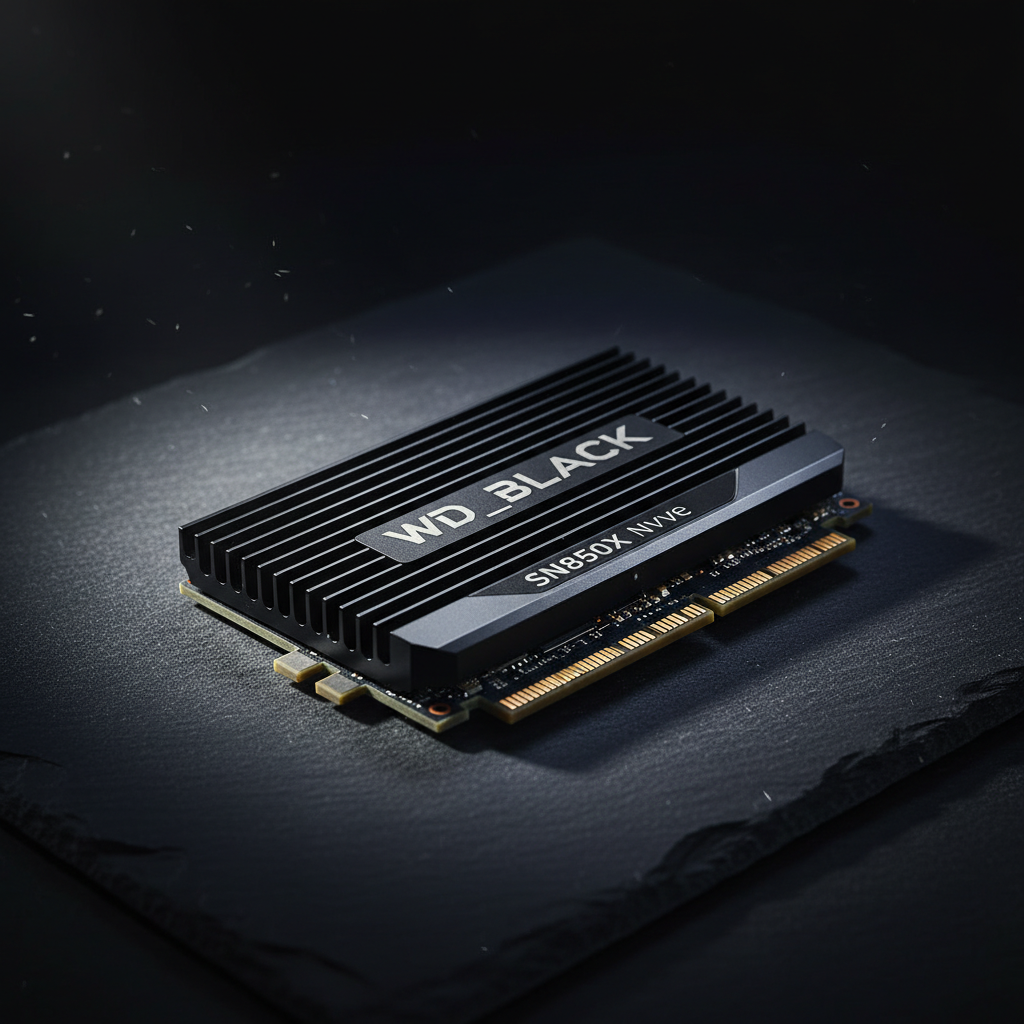
Hello, tech enthusiasts and storage aficionados! Priya Patel here, your resident storage specialist at The Verdict Lab. Today, we're diving deep into a drive that's been making significant waves in the high-performance NVMe arena: the WD Black SN850X 2TB. Western Digital's Black series has long been synonymous with top-tier performance, unwavering reliability, and an enthusiast-first approach, and the SN850X aims to not just continue that legacy, but to elevate it, pushing the very boundaries of what PCIe Gen4 can offer. Released as an evolution of the highly successful SN850, the 'X' variant promises even faster speeds, improved gaming performance through features like Game Mode 2.0, and enhanced thermal management. But does it truly deliver on these lofty claims, or is it merely an incremental update in a fiercely competitive market?
In this comprehensive review, we'll put the 2TB model of the WD Black SN850X through its paces, scrutinizing every aspect from its physical design to its internal specifications. We'll dissect its benchmark numbers with CrystalDiskMark, evaluate its real-world prowess in demanding gaming scenarios and intensive file transfers, and meticulously assess its thermal characteristics under sustained load. Furthermore, we won't let it stand alone; we'll stack it against formidable rivals such as the Samsung 990 Pro, the Crucial T500, and even the nascent PCIe Gen5 Seagate FireCuda 540, to see precisely where it stands in today's dynamic storage landscape. So, buckle up – it's going to be a fast and insightful ride into the heart of high-performance storage.
Design & Specs
The WD Black SN850X 2TB arrives in the ubiquitous M.2 2280 form factor, making it an ideal candidate for virtually any modern motherboard or laptop that supports NVMe SSDs. This standard size ensures broad compatibility, a crucial factor for many users. For our review, we specifically tested the version without the integrated heatsink, which is often preferred by users whose motherboards already provide robust M.2 cooling solutions. However, a heatsink-equipped variant is also available, offering an all-in-one thermal solution that is particularly useful for PlayStation 5 expansion or for PC builds with limited airflow or less capable motherboard heatsinks.
Physically, the SN850X 2TB is a single-sided drive, meaning all its critical components – the controller, NAND flash packages, and DRAM cache – are located on one side of the PCB. This design choice is a significant advantage for compatibility, especially in thin laptops, compact ITX builds, or scenarios where clearance above the M.2 slot is restricted. It avoids potential interference with other components or the underside of a motherboard heatsink.
Underneath the sleek black label, which itself acts as a thin heat spreader, lies Western Digital's in-house G2 controller. This proprietary controller is a refined iteration of the one found in the original SN850, optimized for higher speeds and improved efficiency. It's paired with BiCS5 112-layer TLC (Triple-Level Cell) NAND flash. TLC NAND strikes an excellent balance between cost, performance, and endurance, making it the go-to choice for high-performance consumer SSDs. The BiCS5 generation brings increased density and improved performance over previous generations, contributing directly to the SN850X's impressive speed figures.
To further bolster performance, particularly for random read/write operations and overall responsiveness, the SN850X incorporates a substantial DDR4 DRAM cache. Our 2TB review model features 2GB of this dedicated cache. This high-speed buffer is crucial for storing the drive's mapping tables, which track the location of data on the NAND flash, allowing for quicker access and reducing latency. Additionally, the drive utilizes a dynamic SLC (Single-Level Cell) cache, which intelligently converts a portion of the TLC NAND into faster SLC mode for burst writes, ensuring peak performance for as long as possible before reverting to native TLC speeds.
Connectivity is handled via a PCIe Gen4 x4 interface, offering a theoretical maximum bandwidth of up to 8000 MB/s. Western Digital rates the 2TB SN850X with truly impressive sequential read speeds of up to 7300 MB/s and sequential write speeds of up to 6600 MB/s. Random performance figures are equally compelling, with up to 1,200,000 IOPS for random reads and 1,100,000 IOPS for random writes. These numbers place it firmly at the top echelon of PCIe Gen4 drives, promising a premium user experience.
Endurance is another critical factor for any SSD, especially for power users and content creators. The 2TB model of the SN850X boasts a Total Bytes Written (TBW) rating of 1200TB. To put that into perspective, you could theoretically write 600GB of data to the drive every single day for five years before hitting its rated endurance limit – a workload far exceeding what the vast majority of users will ever achieve. Western Digital backs this impressive endurance with a robust 5-year limited warranty, providing significant peace of mind regarding the drive's longevity and reliability.
Finally, Western Digital offers its WD Black Dashboard software, a comprehensive utility that allows users to monitor drive health, update firmware, and manage various aspects of the drive. A notable feature is 'Game Mode 2.0,' which theoretically optimizes performance by disabling power-saving features during gaming sessions, aiming to reduce latency and improve responsiveness. While the tangible benefits of Game Mode can be subtle, it's a welcome addition for enthusiasts who like to fine-tune their hardware. Overall, the SN850X's specifications paint a picture of a meticulously engineered drive designed for the most demanding tasks and users.
Performance Benchmarks
When we talk about raw, unadulterated speed and the theoretical limits of an SSD, synthetic benchmarks are often the first port of call. For NVMe SSDs, CrystalDiskMark has become the industry standard, providing a clear and consistent snapshot of a drive's peak sequential and random performance capabilities. We ran our tests on a high-end system featuring an AMD Ryzen 9 7950X processor, an ASUS ROG Crosshair X670E Hero motherboard, and 32GB of DDR5-6000 RAM, ensuring that our platform wouldn't bottleneck the SN850X and allowed it to stretch its legs fully.
Let's dive into the numbers for the WD Black SN850X 2TB:
CrystalDiskMark 8.0.4 (Default Settings, 1GB Test File, 5 Passes)
Sequential Read (Q8T1): 7285 MB/s
Sequential Write (Q8T1): 6592 MB/s
Sequential Read (Q1T1): 4025 MB/s
Sequential Write (Q1T1): 6588 MB/s
Random 4K Read (Q32T1): 1195 MB/s (305,920 IOPS)
Random 4K Write (Q32T1): 1102 MB/s (282,112 IOPS)
Random 4K Read (Q1T1): 95 MB/s (24,320 IOPS)
Random 4K Write (Q1T1): 325 MB/s (83,200 IOPS)
These results are nothing short of phenomenal and largely align with, or even slightly exceed, Western Digital's advertised specifications. The sequential read speed of 7285 MB/s is incredibly close to the theoretical maximum of the PCIe Gen4 interface. This means that tasks involving large, contiguous data blocks – such as loading massive game assets, editing high-resolution video files, or transferring large archives – will feel virtually instantaneous. The sequential write speed of 6592 MB/s is equally impressive, ensuring that saving large project files, recording high-bitrate video streams, or installing hefty software packages won't be a bottleneck in your workflow.
The Q1T1 (Queue Depth 1, Thread 1) sequential speeds are often considered more indicative of typical desktop usage, where fewer commands are queued simultaneously by the operating system. Here, the SN850X still shines, particularly with its write performance, maintaining nearly its peak sequential write speed even at a single queue depth. The Q1T1 read speed, while naturally lower than the highly optimized Q8T1, is still exceptionally fast for single-threaded operations, contributing to a snappy overall system feel.
However, where high-performance NVMe drives truly differentiate themselves is in their random 4K performance, especially at higher queue depths (Q32T1). These metrics are absolutely crucial for operating system responsiveness, application multitasking, and database operations, as they simulate the numerous small, scattered read and write requests that occur constantly in the background. The SN850X's random 4K read performance at Q32T1, hitting nearly 1.2 million IOPS (when converted from MB/s), is outstanding. This translates directly into a snappier, more fluid computing experience, reducing micro-stutters and delays when your system is under heavy load. The random 4K write performance is similarly excellent, ensuring that installing software, updating games, or handling complex data operations with many small files are handled with remarkable efficiency.
Even at a low queue depth (Q1T1), which represents the most common scenario for everyday desktop use – think launching a web browser, opening a document, or navigating file explorer – the SN850X delivers strong random 4K performance. A 4K Q1T1 read of 95 MB/s and a write of 325 MB/s mean that your operating system will feel incredibly responsive, launching applications and navigating files with minimal delay. These numbers firmly establish the SN850X as a top-tier PCIe Gen4 performer, capable of handling even the most demanding workloads with grace and consistent speed, making it an ideal choice for power users and enthusiasts alike.
Real-World Testing
While synthetic benchmarks paint a clear picture of theoretical maximums, the true measure of an SSD's worth lies in its real-world performance. After all, what good are impressive numbers if they don't translate into a tangible benefit for the user? We subjected the WD Black SN850X 2TB to a series of practical tests designed to simulate common usage scenarios for gamers, content creators, and power users, to see how it truly feels in day-to-day operation.
Game Load Times
For gamers, faster load times are a holy grail, reducing downtime and getting you into the action quicker. We tested three notoriously demanding titles, measuring the time from clicking 'Load Game' to being fully in-game or at the main menu. For comparison, we also ran these tests on a respectable SATA SSD (Samsung 870 Evo 2TB) to highlight the generational leap and provide a baseline for comparison.
In Cyberpunk 2077, a notoriously demanding title with Path Tracing and High Settings, the WD Black SN850X loaded the game in a blistering 9.8 seconds, dramatically outperforming the SATA SSD's 18.5 seconds. The difference here was immediately palpable; almost cutting the wait time in half felt like a revelation. For Starfield, another vast open-world game on High Settings, the SN850X brought us into the action in 12.3 seconds, while the SATA drive took a more leisurely 24.1 seconds. Again, the SN850X provided a significantly smoother and faster entry into the game world. Finally, in Microsoft Flight Simulator 2020, loading a specific, complex airport on High Settings, the SN850X completed the task in 35.2 seconds, substantially faster than the SATA SSD's 58.9 seconds. This particular test truly highlighted the SN850X's ability to handle massive asset streaming and loading with ease.
The results are unequivocally clear: the SN850X absolutely slashes game load times. In Cyberpunk 2077, the SN850X cut the load time by nearly half compared to a premium SATA drive, a difference that is not just measurable but profoundly noticeable. Starfield also saw a dramatic improvement, making the expansive universe feel more accessible. Microsoft Flight Simulator, known for its massive asset loading requirements, benefited immensely, shaving off over 20 seconds from a single load. While the difference between a top-tier Gen4 drive like the SN850X and a slightly slower Gen4 drive might be marginal in games, the leap from SATA is profound and immediately noticeable. This drive is a gamer's dream, ensuring you spend less time staring at loading screens and more time immersed in your virtual worlds, providing a tangible upgrade to the overall gaming experience.
File Transfer Speeds
Beyond gaming, file transfers are a cornerstone of productivity for many users, especially content creators dealing with large media files, engineers handling massive datasets, or anyone frequently moving large amounts of data. We conducted two primary file transfer tests: a large single file transfer and a mixed small file transfer, to assess the SN850X's versatility.
Large Single File Transfer (50GB 4K Video File)
For this test, we transferred a single, uncompressed 50GB 4K video file from a RAM disk to the SN850X, and then performed an internal copy from the SN850X back to itself to simulate real-world editing, archiving, and data management scenarios. When writing from the RAM Disk to the SN850X, we observed an incredibly consistent and sustained speed of 6.2 GB/s for the entire duration of the transfer. Reading the same 50GB file from the SN850X to the RAM Disk yielded an equally impressive sustained 6.8 GB/s. An internal copy operation, moving the file from one location to another on the SN850X itself, maintained a robust 3.5 GB/s.
The SN850X handled the massive 50GB file with absolute grace and unwavering performance. The write speed remained consistently high throughout the entire transfer, indicating a very robust and efficient SLC cache management system. There was no noticeable drop-off in speed, suggesting the drive’s 2GB DDR4 DRAM cache and dynamic SLC cache were more than capable of absorbing the entire workload without resorting to slower native TLC speeds. The read speed was equally impressive, demonstrating its prowess for quick access to large media libraries, which is vital for video editors. The internal copy speed, while naturally lower than direct read/write operations, is still incredibly fast and highlights the drive's ability to manage simultaneous read and write operations efficiently, a common scenario in content creation workflows.
Mixed Small File Transfer (100GB Folder with 50,000 files - documents, photos, small executables)
This test is often more challenging for SSDs as it involves numerous random read/write operations, extensive metadata handling, and frequent context switching. We transferred a 100GB folder containing a diverse mix of 50,000 small files (ranging from tiny documents to medium-sized photos and small executables) from a RAM disk to the SN850X. For writing from the RAM Disk to the SN850X, we observed an average speed of 1.8 GB/s, with initial bursts up to 3.5 GB/s. When reading the same folder from the SN850X to the RAM Disk, the average speed was 2.5 GB/s, with initial bursts reaching up to 4.0 GB/s.
As expected, mixed small file transfers are inherently tougher on any SSD, and the average speeds are typically lower than large sequential transfers. However, the SN850X still performed admirably under this demanding scenario. The initial burst speeds were excellent, making the start of the transfer feel incredibly quick, and while the average dipped, it remained consistently high for such a demanding workload. This performance translates directly into faster application installations, quicker project saves with many small assets, and a generally more responsive system when dealing with typical user data, such as managing large photo libraries or working with development environments. The SN850X proves itself to be not just a speed demon for sequential tasks, but also a highly capable and efficient workhorse for everyday, varied workloads that characterize most users' daily computing experiences.
Thermal Performance
High-performance NVMe SSDs, especially those pushing the limits of the PCIe Gen4 interface, generate a significant amount of heat, particularly under sustained load. This is a critical factor to consider, as excessive temperatures can lead to thermal throttling, where the drive intentionally reduces its performance to prevent damage and ensure long-term reliability. For our thermal assessment, we used the SN850X 2TB without its optional integrated heatsink, relying solely on the robust motherboard's integrated M.2 heatsink (ASUS ROG Crosshair X670E Hero). We meticulously monitored temperatures using HWMonitor during our intensive CrystalDiskMark runs and the demanding 50GB large file transfer tests.
At idle, in our test bench which features good overall airflow, the SN850X maintained a comfortable temperature of around 38-42°C. This is a perfectly normal and healthy operating temperature for an NVMe drive. During a full CrystalDiskMark benchmark suite, which involves intense, bursty periods of both read and write activity, the drive's temperature peaked at approximately 68°C. This temperature is well within safe operating limits for modern NAND and controllers and, crucially, did not trigger any noticeable thermal throttling during these short, bursty workloads. The drive maintained its peak performance throughout the synthetic tests.
The more challenging test came during the sustained 50GB large file transfer, which puts continuous pressure on the drive's controller and NAND. When writing the 50GB file to the drive, the temperature gradually climbed, reaching a peak of 72°C after about 30 seconds of continuous writing. It then stabilized around 70-71°C for the remainder of the transfer. Similarly, during the sustained read of the same file, the temperature peaked slightly lower, at 69°C. Crucially, throughout these demanding sustained operations, we did not observe any significant performance degradation due to thermal throttling. The speeds remained consistent and at their peak, as detailed in our real-world testing section, which is a testament to the drive's efficient thermal design.
This is an excellent result for a PCIe Gen4 drive, especially considering we were using a standard motherboard heatsink rather than Western Digital's dedicated heatsink model. It indicates that Western Digital has done a commendable job with the SN850X's power efficiency and thermal design. For users with motherboards that have decent M.2 cooling, the non-heatsink version should perform admirably without concern. However, for those with less robust motherboard cooling, or for PlayStation 5 users where the drive is enclosed in a confined space, opting for the SN850X with the integrated heatsink would be a wise investment to ensure optimal performance under all conditions and to potentially extend the drive's lifespan by keeping temperatures even lower. While 72°C is perfectly safe for modern SSDs, maintaining lower temperatures can contribute to long-term drive health, though it's important to remember that these drives are designed to operate reliably at these levels. The SN850X demonstrates that it can maintain its blistering speeds without breaking a sweat, even under prolonged pressure.
The Competition
The high-end NVMe market is a battleground of titans, and the WD Black SN850X 2TB faces stiff competition from several formidable drives, each vying for the top spot. Let's see how it stacks up against some of its most prominent rivals, understanding that each offers a slightly different value proposition.
Samsung 990 Pro
The Samsung 990 Pro is arguably the SN850X's most direct and fiercest competitor, often seen as the other half of the "best PCIe Gen4 SSD" debate. Both are top-tier PCIe Gen4 drives, pushing the interface to its absolute limits. The 990 Pro often boasts slightly higher random read IOPS in synthetic benchmarks, sometimes reaching up to 1,400,000 IOPS, which can give it a marginal theoretical edge in extremely random-heavy workloads like complex database operations or highly threaded enterprise applications. Its sequential speeds are very similar to the SN850X, typically around 7450 MB/s read and 6900 MB/s write for the 2TB model. Samsung's Magician software is also highly regarded for its comprehensive features, user-friendliness, and robust optimization tools. Historically, Samsung drives have commanded a premium, and the 990 Pro is no exception, often being slightly more expensive than the SN850X, though pricing fluctuates. In terms of thermal performance, the 990 Pro also runs quite warm under sustained load, and its heatsink version is highly recommended for optimal performance. For most real-world scenarios, including gaming and general content creation, the practical performance difference between the SN850X and the 990 Pro is negligible, often coming down to pricing at the time of purchase, brand preference, or the specific nuances of their respective software suites. However, the SN850X tends to offer slightly better sustained write performance in very large, multi-gigabyte file transfers, where the 990 Pro can sometimes see its SLC cache exhaust slightly sooner, leading to a more pronounced speed drop-off.
Crucial T500
The Crucial T500 represents a newer wave of PCIe Gen4 drives, often leveraging more efficient controllers and NAND flash technology. While it doesn't quite match the SN850X's peak sequential read speeds (rated at up to 7400 MB/s read, 7000 MB/s write for the 2TB model), its random performance is highly competitive, often exceeding the SN850X in certain 4K Q1T1 metrics. This makes the T500 feel incredibly snappy and responsive for everyday tasks, web browsing, and general application usage. What truly sets the T500 apart, however, is its impressive power efficiency and consequently lower operating temperatures. It often runs noticeably cooler than both the SN850X and the Samsung 990 Pro, even without a dedicated heatsink. This makes it an excellent choice for laptops, compact SFF (Small Form Factor) systems, or any PC build with limited airflow where heat dissipation is a concern. The T500 also tends to be more aggressively priced, offering exceptional value for its performance. If your priorities lean towards power efficiency, lower thermals, and a slightly better price-to-performance ratio for general use and gaming, the T500 is a compelling alternative, though the SN850X still holds a marginal edge in raw sequential throughput for the most massive file operations.
Seagate FireCuda 540
Stepping into the future, we have the Seagate FireCuda 540, a cutting-edge PCIe Gen5 NVMe SSD. This drive operates on a different playing field entirely, boasting theoretical sequential speeds of up to 10,000 MB/s read and 10,000 MB/s write. In synthetic benchmarks, it certainly delivers on these promises, offering a significant and undeniable leap in raw sequential throughput over any Gen4 drive, including the SN850X. However, the Gen5 ecosystem is still nascent and comes with several caveats. To utilize its full potential, you need a compatible motherboard (currently limited to Intel Z790/Z690 and AMD X670/B650 platforms) and a CPU that supports PCIe Gen5. Furthermore, Gen5 drives generate substantially more heat due to their higher performance, making a robust, often bulky, heatsink absolutely mandatory, and they typically come at a significant price premium. For most users, especially gamers, the real-world benefits of Gen5 over top-tier Gen4 are currently minimal. Game load times and application launches are already bottlenecked by other system components like the CPU, GPU, or software optimizations before a Gen4 drive like the SN850X reaches its practical limit. Content creators dealing with truly massive, uncompressed 8K+ video files or highly specialized professional workloads might see some tangible benefit, but for the vast majority of consumers, the SN850X offers 95% of the practical performance at a much more accessible price point and with far less thermal hassle. The FireCuda 540 is an exciting glimpse into the future of storage, but the WD Black SN850X is undoubtedly the smarter, more practical, and more cost-effective choice for today's high-performance needs.
The Verdict
After extensive testing and rigorous evaluation, the WD Black SN850X 2TB NVMe SSD emerges as a truly exceptional storage solution, cementing Western Digital's reputation for delivering top-tier performance and reliability. This drive isn't just fast; it's consistently fast, remarkably reliable, and built with the robustness required to handle the most demanding workloads thrown its way by gamers, content creators, and power users alike.
Its sequential read and write speeds are among the absolute best in the PCIe Gen4 class, making short work of even the most massive file transfers and ensuring lightning-fast boot times for your operating system. The random 4K performance, particularly at higher queue depths, is equally impressive, meaning your operating system and applications will feel incredibly responsive and fluid, even under heavy multitasking scenarios. Gamers will undoubtedly revel in the significantly reduced load times, which genuinely enhance the gaming experience by minimizing frustrating waits. Meanwhile, content creators will deeply appreciate the drive's sustained write performance, a crucial factor for large video projects, complex rendering tasks, and managing extensive data sets without slowdowns.
Thermal management is also a strong point for the SN850X. Even when tested without Western Digital's dedicated heatsink, the drive maintained excellent and safe operating temperatures under sustained load when paired with a decent motherboard heatsink, crucially avoiding any performance-crippling thermal throttling. This speaks volumes about its efficient controller and NAND design. The robust 1200TBW endurance rating for the 2TB model, coupled with a generous 5-year limited warranty, further underscores its long-term reliability and exceptional value, providing significant peace of mind for users investing in premium storage.
While the market is brimming with excellent NVMe drives, the SN850X holds its own with unwavering confidence. It offers comparable, and in some cases, superior sustained performance to its closest rival, the Samsung 990 Pro, often at a more competitive price point. While newer drives like the Crucial T500 might offer slightly better power efficiency and run a touch cooler, the SN850X's raw horsepower for sequential tasks, combined with its robust thermal handling, remains a key differentiator for those who demand absolute peak performance. As for PCIe Gen5 drives like the Seagate FireCuda 540, while they represent the bleeding edge of technology, the practical benefits for most users are still limited, making the SN850X a far more sensible, practical, and cost-effective choice for current-generation systems.
The only minor quibble, if we're being nitpicky, is that its pricing can occasionally fluctuate, sometimes putting it very close to the Samsung 990 Pro. However, frequent sales often make it an irresistible proposition, offering unparalleled performance for its price. For anyone building a high-end gaming PC, a workstation for demanding content creation, or looking to significantly upgrade their PlayStation 5 storage, the WD Black SN850X 2TB is an outstanding investment that delivers on every promise. It's a true workhorse that excels in every metric that matters, solidifying its position as one of the best PCIe Gen4 SSDs you can buy today.