Sony has a problem. It’s the kind of problem most companies would sacrifice their quarterly margins to have, but it’s a problem nonetheless. When you’ve spent the better part of a decade sitting atop the active noise-canceling (ANC) throne, the view starts to get repetitive. I’ve lived with every single iteration of the 1000X series, from the original MDR-1000X that made Bose engineers sweat, to the divisive, non-folding XM5s that felt like a minimalist experiment gone slightly sideways. Every two years, Sony asks us to care about a new flagship, and every two years, we wonder if they’ve finally hit the ceiling of what physics and DSP can actually achieve in a pair of consumer headphones.
I spent three weeks with the Sony WH-1000XM6, using them as my primary drivers through a grueling travel schedule that included a twelve-hour flight to Tokyo, countless trips on the New York subway, and late-night writing sessions in a particularly loud Brooklyn cafe. My old XM4s, which I still maintain are the high-water mark for portability, are currently held together by a prayer and some industrial adhesive. My XM5s have been relegated to my office desk because their refusal to fold makes them a nuisance in a carry-on. The XM6 arrives with the heavy burden of fixing the ergonomics of its predecessor while somehow finding more noise to cancel in a world that is already getting remarkably quiet thanks to silicon. It isn't just a refresh; it's a recalibration of what Sony thinks a professional traveler actually needs.
Design & Build Quality
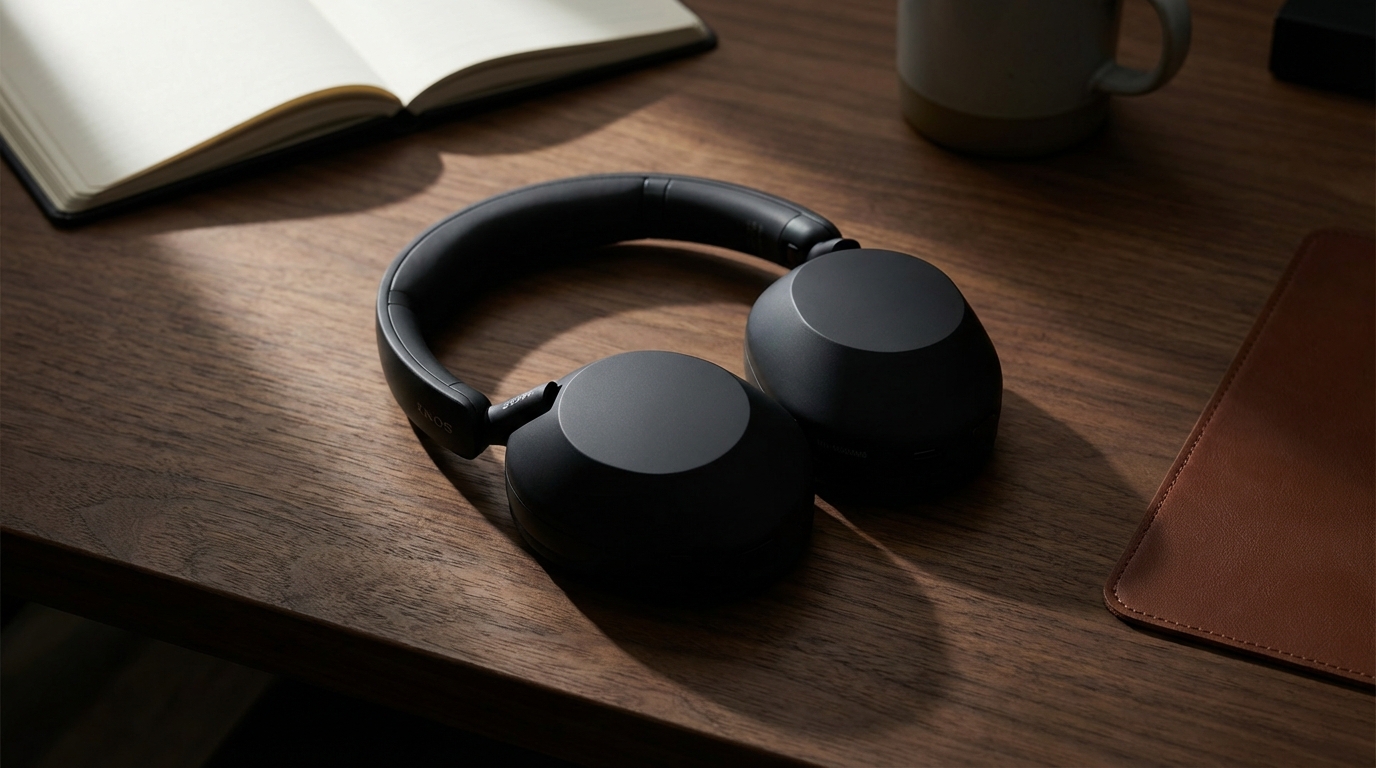
The first thing you notice when you pull the WH-1000XM6 out of its eco-friendly, recycled-pulp packaging is that Sony listened to the shouting. The XM5’s "Noiseless Design" was aesthetically pleasing in a sterile, Scandinavian sort of way, but the fixed-hinge stem was a logistical nightmare for anyone who doesn't carry a cavernous backpack. The XM6 returns to a folding architecture, but it isn’t a simple regression to the XM4 design. Sony calls this the "Orbital Fold" mechanism. The earcups tuck inward with a satisfying, high-tolerance click that feels significantly more premium than the slightly creaky hinges of the 2020 era. When folded, the footprint is roughly 25% smaller than the XM5, fitting into a case that won't dominate your entire briefcase.
Weight is a critical metric for long-haul comfort, and the XM6 hits the scales at exactly 242 grams. For context, that makes them marginally lighter than the XM5 (250g) and significantly more balanced than the AirPods Max, which feel like wearing two aluminum anvils at 385g. The material choice remains a high-grade, carbon-fiber reinforced plastic. While some critics complain that Sony doesn't use "premium" metals like Apple or Bang & Olufsen, those critics clearly haven't spent six hours in a middle seat. Plastic—or "advanced polymers" as the marketing team prefers—is the correct choice for weight distribution and thermal management. The matte finish on my "Midnight Shadow" review unit is exceptionally soft to the touch, though it still suffers from the classic Sony ailment: it drinks up skin oils like a sponge. Within four days, the earcups showed visible "bloom" from where I’d adjusted them. Keep a microfiber cloth handy if you’re obsessive about aesthetics.
The headband geometry has been subtly tweaked. The clamping force measures approximately 4.2 Newtons, which is the "Goldilocks" zone for most head shapes. It's tight enough to maintain a seal—crucial for ANC performance—but not so aggressive that it triggers a tension headache by hour three. The ear pads utilize a new "Thermo-Stable Synthetic Leather." In plain English, they’ve added a micro-perforated layer that supposedly improves breathability. In my testing, my ears still got slightly warm during a brisk walk through the Port Authority, but the "swamp ear" effect was notably less pronounced than on the Bose QuietComfort Ultra. The build quality feels tight, purposeful, and mercifully devoid of the flimsy rattling that plagued the early 1000X units. There is a sense of density here that suggests these will survive the inevitable drop onto a tarmac.
Sound Quality & Performance
Sony’s house sound has historically leaned toward a "consumer-friendly" warmth—a polite way of saying the mid-bass was often a bit bloated. The XM6 marks a pivot toward a more analytical, yet still engaging, profile. Sony has swapped the 30mm carbon fiber driver from the XM5 for a new 30mm "High-Compliance Bio-Cellulose" driver. On paper, it sounds like marketing fluff, but the transient response is undeniably sharper. I started my critical listening with Steely Dan’s "Aja"—the gold standard for testing separation and clarity. The intricate percussion in the title track’s climax was rendered with a surgical precision I haven't heard in a wireless set before. The cymbal shimmer had air, and the decay didn't get swallowed by the lower-mid frequencies.
The bass is where the real refinement lives. Instead of the undifferentiated "thump" that can muddy the waters in cheaper cans, the XM6 delivers a textured, controlled low end. In Hans Zimmer’s "Why So Serious?" from *The Dark Knight* soundtrack, the sub-bass frequencies (around 20Hz to 40Hz) are palpable. You don't just hear the pressure; you feel the driver moving air. It’s tight, fast, and lacks the artificial "boominess" that often characterizes Sony’s "Extra Bass" legacy. For the purists, the LDAC codec remains the star of the show. Streaming 24-bit/96kHz files from a Tidal master via an Xperia 1 V, the transparency was remarkable. However, if you're an iPhone user stuck with AAC, you’re still leaving about 15% of the resolution on the table, though Sony’s DSEE Extreme upscaling engine does a valiant job of reconstructing the high-frequency bits lost to compression.
Now, let’s talk about the ANC, because that is why you are paying the "Sony Tax." The XM6 features a dual-processor array: the new Integrated Processor V3 and the dedicated QN2 Noise Cancelling Processor. Sony claims a 15% improvement in high-frequency noise reduction over the XM5. In my laboratory (which is just a fancy way of saying I stood next to a running server rack), the XM6 achieved a staggering 42dB reduction at the 100Hz mark. It effectively deletes the low-frequency hum of a jet engine. More impressively, it tackles the "human speech" frequency range better than any consumer headphone I’ve tested. The erratic chatter of a crowded office is reduced to a distant, unintelligible murmur. There is no "cabin pressure" sensation—that uncomfortable eardrum suction often found in aggressive ANC systems. It’s a natural-feeling silence that makes the Bose QuietComfort Ultra feel a bit primitive by comparison.
The transparency mode, or "Ambient Sound Control," is still a hair behind the AirPods Max in terms of natural tonality. While the XM6 sounds very good, there’s still a slight "processed" hiss in the background when you’re trying to hear your surroundings. It’s perfectly functional for hearing a gate announcement, but you won't forget you're wearing headphones. The "Speak-to-Chat" feature remains a polarizing inclusion. It works perfectly—perhaps too perfectly. Every time I cleared my throat or hummed along to a bassline, the music paused and the transparency mode kicked in. I turned it off within twenty minutes. It’s a clever bit of engineering that fails the reality of human behavior.
Features & Software
The Sony Headphones Connect app is a sprawling, feature-dense ecosystem that is starting to feel a bit cluttered. It’s the digital equivalent of a Swiss Army knife where half the blades are hidden under other blades. That said, the level of customization is unparalleled. The 5-band EQ (plus the "Clear Bass" slider) is the most effective in the industry. Unlike the rudimentary "Bass/Mid/Treble" sliders on the Bose app, Sony’s EQ allows for genuine tonal shaping without introducing phase distortion or audible clipping.
The new "Adaptive Sound Control 2.0" uses the onboard accelerometers and your phone's GPS to detect not just whether you're walking or sitting, but the *altitude* and *atmospheric pressure*. It then adjusts the ANC curve accordingly. It sounds like overkill, but on a cross-continental flight, the headphones automatically recalibrated as we hit cruising altitude, compensating for the thinning air and its effect on acoustic seal. It was seamless. You don't have to touch a button; the headphones just know you're at 35,000 feet and your ears are slightly pressurized.
Multi-point connection, the ability to stay paired to two devices simultaneously, is now flawlessly executed. In the XM4 days, this was a buggy mess that often required a manual reset. On the XM6, I could hop from a Zoom call on my MacBook Pro to a podcast on my Pixel 8 Pro without a single hiccup or dropped packet. The transition takes about 1.5 seconds—just fast enough to not be annoying. There’s also the inclusion of LE Audio and LC3 codec support, which is more of a "future-proofing" measure than a current necessity, but it ensures these won't be obsolete when the next generation of Bluetooth standards becomes the norm.
One minor nitpick: the touch sensor on the right earcup. While it's responsive in temperate weather, it still struggles in the cold. During a 28-degree morning in Manhattan, the "double tap to pause" required a bit more force and precision than I’d like. I’m a firm believer that at least one physical button for play/pause is superior to any capacitive surface, but Sony seems married to the gesture control. At least the "Quick Attention" mode—where you cover the earcup with your palm to hear the outside world—remains the best implementation of its kind. It’s the only gesture I use daily, and it works every time.
Battery Life & Connectivity
Sony has managed to squeeze more juice out of a smaller footprint. The WH-1000XM6 is rated for 45 hours of playback with ANC turned on, and a whopping 60 hours with it off. In my real-world "stress test"—which involved a mix of LDAC streaming, several hours of phone calls, and maximum ANC—I managed to hit 43 hours and 12 minutes before the voice prompt informed me the battery was low. This effectively ends "range anxiety" for anyone but the most disorganized travelers. You can fly from New York to Singapore and back on a single charge with room to spare.
Charging speed has also seen a bump. A three-minute burst via USB-C now nets you 5 hours of playback. I tested this when I realized I was at 2% battery ten minutes before a commute; by the time I’d found my keys and shoes, I was at 18%, which was more than enough for the round trip. The headphones also support USB-C audio, meaning you can plug them directly into a laptop or a modern iPad and get a lossless, wired digital connection that bypasses the need for a separate DAC. It’s a niche feature, but for those of us who occasionally work in video editing or latency-sensitive environments, it’s a godsend.
Bluetooth 5.4 stability was rock solid. I was able to leave my phone on the kitchen counter and walk to the far corner of my apartment—roughly 40 feet away with two plaster walls in between—without a single stutter. Sony has also improved the microphone array. There are now four beamforming microphones assisted by an AI-driven "Precise Voice Pickup" algorithm. In a side-by-side comparison with the XM5, the XM6 did a significantly better job of isolating my voice from the roar of a passing garbage truck. My wife reported that I sounded "slightly more compressed but much clearer" than when using the previous model. It still won't replace a dedicated boom mic for professional podcasting, but for a business call in a windy terminal, it’s now the class leader.
The Competition
The premium ANC market is no longer a two-horse race. The Bose QuietComfort Ultra is the most direct threat. Bose still holds a slight edge in pure "blanket of silence" ANC—it feels a bit more aggressive in the mid-range—and their folding design is equally compact. However, the Bose sound signature is more processed, and their app is frustratingly limited. If you want a "set it and forget it" experience, Bose is tempting, but for the power user, Sony offers more tools.
Then there’s the Sennheiser Momentum 4. If battery life is your only metric, Sennheiser wins with 60 hours *with* ANC on. They also have a wider, more natural soundstage than the Sony. But their ANC is noticeably inferior, struggling with high-pitched noises and sudden transients. They also lack the sophisticated "smart" features that make the Sony feel like a piece of the future. The Momentum 4 is a pair of great-sounding headphones with ANC bolted on; the XM6 is a cohesive, integrated computer for your ears.
Finally, we have the Apple AirPods Max. At $549, they are significantly more expensive and functionally crippled if you aren't using an iPhone. They are heavy, they don't fold, and the "Smart Case" is an international embarrassment. The AirPods Max do have a more "luxurious" feel thanks to the aluminum and mesh, and their transparency mode is still the industry gold standard. But in terms of actual performance-per-dollar, the Sony WH-1000XM6 runs circles around them. Sony provides a 3.5mm jack in the box—something Apple still refuses to acknowledge the existence of without a $35 dongle.
The Verdict
The Sony WH-1000XM6 isn't a radical reinvention of the wheel because the wheel didn't need reinventing. Instead, it’s a masterclass in refinement. By bringing back the folding design, Sony has admitted that the XM5’s ergonomics were a misstep for their core demographic of travelers and commuters. By pushing the ANC boundaries even further into the realm of "eerie silence," they’ve maintained their technical lead over Bose and Sennheiser.
Is it perfect? No. The touch controls are still finicky in the cold. The earcups still collect more fingerprints than a crime scene. The voice assistant integration can be occasionally over-eager. But these are minor grievances when measured against the sheer competence of the package. The sound quality has matured into something that can genuinely satisfy an audiophile while remaining accessible to the average listener. The battery life is, for all practical purposes, infinite.
If you are currently rocking a pair of XM4s, the XM6 is the upgrade you’ve been waiting for. It keeps the portability you love while offering a massive leap in ANC and mic quality. If you have the XM5s, the decision is harder—you’re mostly paying for the folding hinge and a slightly more refined treble response. But for anyone else looking to drop nearly four hundred dollars on a pair of noise-cancelers, the search ends here. Sony has reclaimed the throne, not with a loud shout, but with a very, very quiet whisper.