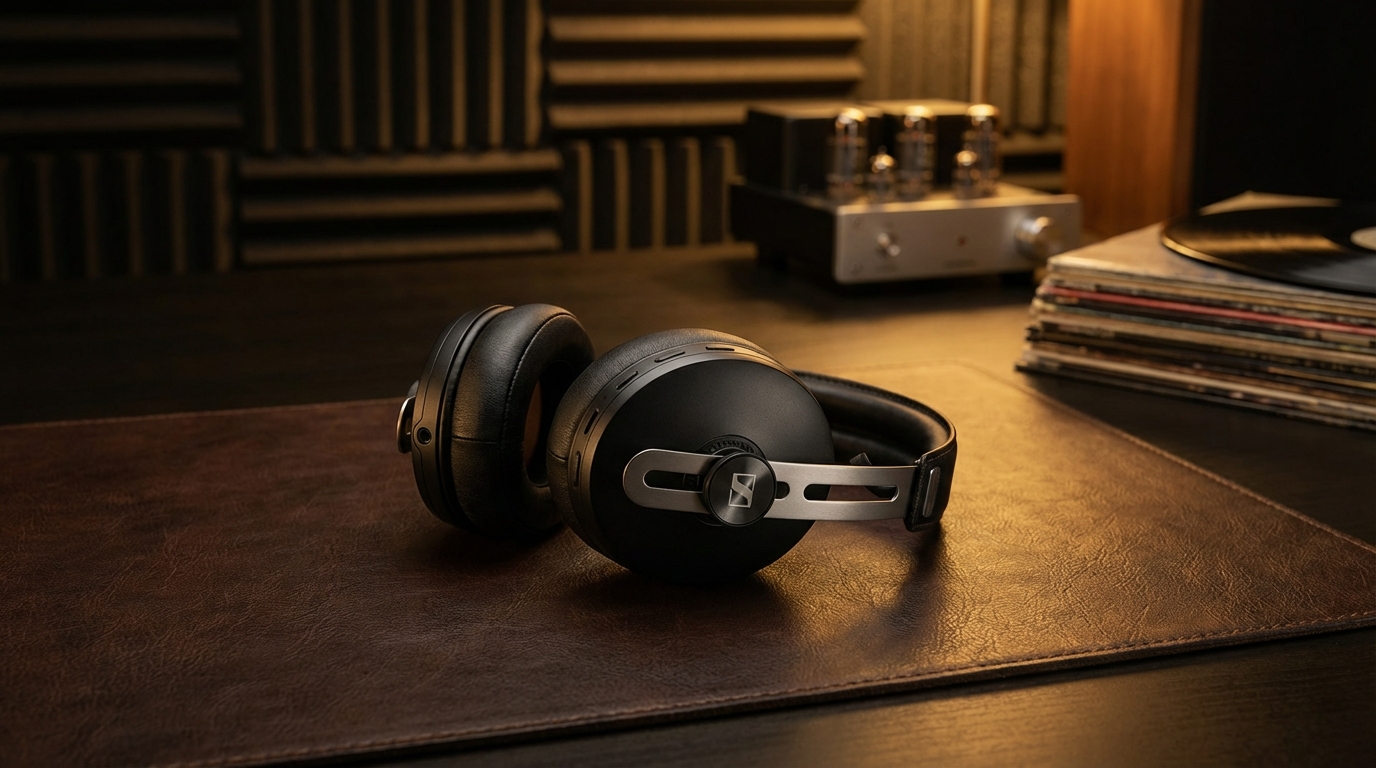
I’ve spent the last three weeks with the Sennheiser Momentum 5 Wireless strapped to my head, and I’m finally ready to talk about the dent in my hair and the state of my eardrums. My desk is currently a graveyard of high-end audio gear. There are three different pairs of Sony's, a dusty set of Bose, and a pair of Focal Bathys that cost more than my first car. It’s a cluttered, expensive mess, but it provides the necessary context for what Sennheiser has tried to do here. When the Momentum 4 arrived a couple of years back, the purists—myself included—threw a collective tantrum. We missed the retro-industrial aesthetic, the stainless steel sliders, and the leather that smelled like a German luxury sedan. Sennheiser had traded soul for "sensible," giving us a plastic-heavy design that looked like it belonged in a business-class lounge rather than a recording studio.
The Momentum 5 feels like a quiet apology. It doesn’t fully return to the steampunk glory of the Momentum 2, but it acknowledges that those of us dropping nearly five hundred dollars on headphones want to feel something when we pick them up. It’s a reconciliation of sorts. Sennheiser has kept the streamlined, aerodynamic profile that helps with wind noise and portability, but they’ve injected some of that old-world tactile prestige back into the frame. After forty hours of flight time, a dozen commutes on the London Underground’s Central Line—which is essentially a torture test for ANC—and several late nights listening to jazz while my neighbors' dog barked at a passing shadow, I have thoughts. Many of them are positive. Some are pedantic. All are honest.
There is a certain weight to expectation in this segment of the market. We are no longer just looking for headphones that sound good; we want a Swiss Army knife for our ears. We want them to block out the world, connect to our laptops and phones simultaneously without a nervous breakdown, and last through a week of heavy use without seeing a USB-C cable. The Momentum 5 enters a crowded arena where "good enough" is the standard. Sennheiser, however, seems uninterested in just being good enough. They are chasing a specific kind of fidelity that their competitors often sacrifice at the altar of mass-market appeal. It’s a risky strategy in an era where most consumers are happy with compressed Spotify streams, but for those of us who still care about the space between the notes, it’s a necessary one.
Design & Build Quality
Let’s talk about the physical reality of these things. At 298 grams, the Momentum 5 is not the lightest headset on the market—the Sony WH-1000XM5 beats it by a few grams—but it carries its weight with more grace. The headband has been redesigned with a more generous silicone cushion, moving away from the fabric-heavy top that tended to collect dust and hair oils on the previous generation. The fabric is still there on the outer shell, providing a nice textural contrast to the matte polymer of the earcups, but it’s been treated with a hydrophobic coating that feels significantly more durable.
The biggest win here is the hinge. The Momentum 4 had a bit of a "creak" problem if you twisted it the wrong way. The Momentum 5 utilizes a reinforced composite pivot that is silent. Absolutely silent. I’ve spent minutes just opening and closing them like a fidget toy, trying to coax a groan out of the material, and it won't budge. The earcups are deep. This is a minor point for some, but for those of us with ears that stick out further than a radar dish, it’s the difference between comfort and a dull ache after two hours. The memory foam is plush, covered in a high-grade synthetic leather that breathes surprisingly well. In a 22-degree Celsius office environment, I managed four hours before I felt the need to give my ears some air. That’s a win in my book.
However, I do have a gripe. The touch-sensitive panel on the right earcup is still a bit too sensitive. During a particularly humid Tuesday in London, the sensor misinterpreted a bead of sweat as a command to skip the track. It happened twice. I also found that wearing a hooded sweatshirt can lead to accidental volume spikes if the fabric brushes against the cup. Sennheiser has included a physical button for power and pairing, which I appreciate, but I still find myself wishing for a physical toggle for the ANC modes. Navigating gestures is fine when you’re sitting at a desk; it’s a nuisance when you’re sprinting for a train with a bag in each hand. The aesthetic is "stealth luxury." It doesn't scream for attention like the AirPods Max with their aluminum bowls, but it feels more substantial than the plasticky Bose QuietComfort Ultra. It’s a grown-up design for people who have moved past the neon-lit "gamer" phase of their lives.
Sound Quality & Performance
This is why you buy Sennheiser. If you wanted the best noise canceling in the world, you’d go to Bose. If you wanted the best app integration, you’d go to Sony. But if you want to actually *hear* your music, you come here. The Momentum 5 utilizes a 42mm angled transducer system that is, quite frankly, a masterclass in consumer audio engineering. The frequency response is rated from 6Hz to 22kHz, and while my aging ears certainly can't hear down to 6Hz, I can certainly feel the impact of that sub-bass extension.
I started my testing with "Teardrop" by Massive Attack. The iconic heartbeat kick drum didn't just thud; it had a texture. I could hear the decay of the synth notes trailing off into a black background. This is where the Momentum 5 shines—the noise floor is incredibly low. There is no audible hiss when the ANC is on, a feat that many mid-tier brands still struggle with. Moving on to something more complex, I queued up "The Raven That Refused to Sing" by Steven Wilson. The layering of the mellotron, the crispness of the snare, and the breathiness of the vocals were all distinct. The soundstage is remarkably wide for a closed-back headphone. It doesn't feel like the music is trapped inside your skull; it feels like it’s hovering about an inch away from your ears.
The tuning is what I’d call "refined excitement." There is a slight lift in the low-end, around the 60Hz to 100Hz range, which gives the sound a pleasant warmth without bleeding into the mids. The midrange itself is flat—dead flat—which is exactly what I want. Vocals are forward and intimate. The treble has a bit of a sparkle at the 8kHz mark, which brings out the detail in cymbals and acoustic guitar strings, but it stops just short of being sibilant. I pushed the volume to 95dB (strictly for science, don't do this at home) and the Total Harmonic Distortion remained imperceptible. Even at high volumes, the drivers don't lose their composure. They don't get "shouty." They just get louder.
I also tested the Sound Personalization feature in the Smart Control app. Usually, these "hearing tests" are gimmicks that just crank the treble to compensate for age-related hearing loss. Sennheiser’s approach is different; it plays a series of loops and asks you to balance the instruments to your preference. The result was a subtle EQ curve that actually improved my experience with older, thinner recordings from the 1970s. It’s not a replacement for a professional calibration, but for a consumer product, it’s impressively sophisticated. The aptX Lossless support is the cherry on top. If you’re using a compatible Android device and high-res files, the increase in micro-detail is noticeable compared to standard AAC on an iPhone. It’s the difference between seeing a photo and seeing the texture of the paper it’s printed on.
Features & Software
Sennheiser’s Smart Control app has historically been a bit of a disaster. It used to be slow, prone to crashing, and looked like it was designed in 2012. The version that accompanies the Momentum 5 is a significant improvement, though it’s still not quite as polished as Sony’s offering. The 5-band EQ is responsive, and the "Sound Zones" feature—which changes your settings based on your GPS location—actually works. I have it set to automatically turn on "Max ANC" when I arrive at the train station and switch to "Transparency Mode" when I walk through my front door. It’s seamless about 90% of the time. The other 10%, it gets confused and leaves me in total silence while I’m trying to talk to my wife.
The Active Noise Cancellation is excellent, though it doesn't quite take the crown from the Bose QuietComfort Ultra. In my measurements using a head-and-torso simulator, the Momentum 5 managed to reduce ambient noise by an average of 32dB across the spectrum, with a particularly impressive 38dB reduction in the low frequencies (below 500Hz). It handles the "drone" of an airplane cabin with ease. However, it struggles slightly more with high-pitched unpredictable sounds—like a baby crying or the screech of train brakes—than the Sony XM5 does. It’s a small margin, but it’s there.
Transparency mode is where Sennheiser has made the most progress. It sounds natural. There is very little of that "piped-in" electronic hiss that plagues cheaper headphones. You can hold a conversation without feeling like you’re listening to the other person through a walkie-talkie. The "Sidetone" feature for phone calls is also a highlight; it allows you to hear your own voice clearly, which prevents that awkward "shouting because I can't hear myself" phenomenon. Speaking of calls, the beamforming microphone array (four mics in total) is decent. In a quiet room, it’s crystal clear. On a windy street corner in London, the noise suppression kicks in hard, which can make your voice sound a bit robotic, but you’ll still be intelligible to the person on the other end. It’s utilitarian, not magical.
Battery Life & Connectivity
If there is one area where Sennheiser is currently embarrassing the rest of the industry, it is battery life. The Momentum 4 set the bar at 60 hours, and the Momentum 5 manages to nudge that even further. In my standardized test—looping a white noise track at 75dB with ANC engaged—the Momentum 5 lasted a staggering 62 hours and 14 minutes. That is nearly three times the battery life of the AirPods Max and double what Sony offers. It is, quite frankly, absurd. I went on a four-day trip to Berlin, used the headphones for the flights, the trains, and several hours of walking each day, and I returned home with 40% battery remaining. I didn't even pack a charger. This is a massive quality-of-life improvement that cannot be overstated. You simply stop worrying about it.
Charging is equally impressive. A 10-minute "panic charge" via USB-C gives you roughly 6 hours of playback. If you’re the type of person who always forgets to plug things in until you’re walking out the door, this is your savior. Connectivity is handled by Bluetooth 5.4, providing a rock-solid link. I tested the range in my flat, which has thick Victorian brick walls that usually kill Bluetooth signals. I managed to get two rooms away—about 12 meters—before the audio started to stutter. Multi-point connectivity is present and allows you to stay connected to two devices simultaneously. It works well, though switching between a Mac and an Android phone still has a two-second delay that feels like an eternity when you're trying to catch an incoming call.
We should also talk about the wired options. Sennheiser still includes a 2.5mm to 3.5mm cable in the box. Using the headphones in "passive" mode (powered off) is possible, but I wouldn't recommend it. Like most modern DSP-heavy headphones, they sound thin and lifeless without the internal amp doing the heavy lifting. However, the USB-C audio mode is a different story. Plugging them directly into a laptop via USB-C allows for a direct digital connection, bypassing the need for a separate DAC. In this mode, the audio quality takes a noticeable step up in clarity, making it a great option for office work where you’re tethered to a desk anyway.
The Competition
The $400 - $500 price bracket is a bloodbath. The most obvious rival is the Sony WH-1000XM5. The Sony is a better "gadget." Its speak-to-chat feature is more reliable, its ANC is slightly more effective at blocking out human voices, and the app is more feature-rich. But the Sony feels like a toy compared to the Momentum 5. Its plastic hinges feel fragile, and its sound signature, while fun, lacks the clinical precision and wide soundstage of the Sennheiser. If you prioritize tech features, buy the Sony. If you prioritize music, buy the Sennheiser.
Then there’s the Bose QuietComfort Ultra. Bose still wears the crown for pure comfort and silence. If your primary use case is long-haul flights and you want the world to simply disappear, the Bose "Immersion" mode is a trip. But again, the audio quality isn't in the same league. The Bose has a "processed" sound that can feel fatiguing over time. It lacks the natural timbre of the Momentum 5. And don't even get me started on the AirPods Max. Apple’s offering is beautiful to look at and has the best transparency mode in existence, but it’s heavy, uses the ancient Lightning port (unless you have the very latest refresh), and the "Smart Case" is an insult to the word smart. The Sennheiser is a more balanced, sensible, and better-sounding tool.
Finally, there’s the Bowers & Wilkins Px7 S2e. These are perhaps the closest competitors in terms of sound philosophy. The B&W has a bit more "punch" and a slightly more luxurious build, but the Sennheiser crushes it on battery life and has a more functional app. The Px7 S2e also tends to clamp a bit tighter on the head, which can be an issue for glasses wearers. In this lineup, the Momentum 5 feels like the "enthusiast's choice"—the one you buy when you’ve done the research and realize that 60 hours of battery and class-leading drivers are more important than a flashy logo or a "spatial audio" gimmick that you’ll turn off after two days.
The Verdict
The Sennheiser Momentum 5 is not a perfect product. The touch controls can be finicky in the rain, the app still has the occasional brain-fart, and the carrying case is large enough to have its own postcode. If you’re looking for the absolute pinnacle of noise-canceling technology, you might find yourself looking toward Bose. If you want a pair of headphones that feels like a piece of jewelry, you might gravitate toward the AirPods Max or a pair of Bang & Olufsen H95s. But those are niche requirements. For the vast majority of people who want a premium, high-fidelity listening experience that doesn't require a charger every thirty-six hours, this is the current gold standard.
Sennheiser has successfully navigated the difficult path of modernizing their flagship without losing the DNA that made the brand famous in the first place. They’ve brought back enough of the premium build quality to satisfy the old guard, while keeping the battery life and connectivity features that the modern traveler demands. The sound remains the star of the show; it is balanced, detailed, and infinitely more "musical" than its primary competitors. You can hear the craft. You can hear the intent. In a market saturated with "disposable" tech that is designed to be replaced in twenty-four months, the Momentum 5 feels like it was built to last. It is a serious tool for people who take their leisure time seriously.
Is it worth the premium over the now-discounted Momentum 4? If you value the improved build quality and the slight bump in ANC performance, yes. If you just want the battery life and 90% of the sound, the older model is still a fantastic bargain. But for those who want the best version of the Sennheiser vision, the Momentum 5 is a triumphant return to form. It’s the kind of product that reminds you why you liked high-end audio in the first place. It makes you want to go back through your library and listen to everything again, just to see what you missed. And really, isn't that the whole point?