Alright, let's talk headphones. For years, I've had a soft spot for Sennheiser. They've always been the sensible shoe of audio – perhaps not the flashiest, but consistently delivering sound that simply *works*. And by 'works,' I mean it makes music sound exactly as it should. So, when the Momentum 4 landed on my desk at The Verdict Lab, I admit, my curiosity was piqued, but also a little apprehensive. The Momentum line had, until now, stuck to a design language that was distinctly retro-cool, all metal and leather. The Momentum 4, however, decided to shed that heritage for something… different. A clean slate, if you will. I've spent the last three weeks with these cans glued to my head, from noisy coffee shops to long-haul flights (well, a very long train ride, at least), putting them through the wringer. And let me tell you, there's a lot to unpack.
My daily routine often involves bouncing between an open-plan office, a bustling commute, and late-night focused listening sessions. I need headphones that can adapt, disappear, and, most importantly, make me forget I'm wearing them while delivering an immersive audio experience. My ideal sound profile leans towards neutrality with a touch of warmth in the lower mids, articulate highs that don't pierce, and a bass response that's tight and impactful without overwhelming the rest of the mix. I'm not chasing skull-rattling bass; I'm chasing fidelity. Sennheiser has historically delivered on that front, but with the Momentum 4, they've clearly aimed for a broader audience, embracing the modern wireless headphone paradigm with both arms. Did they stick the landing?
Design & Build Quality
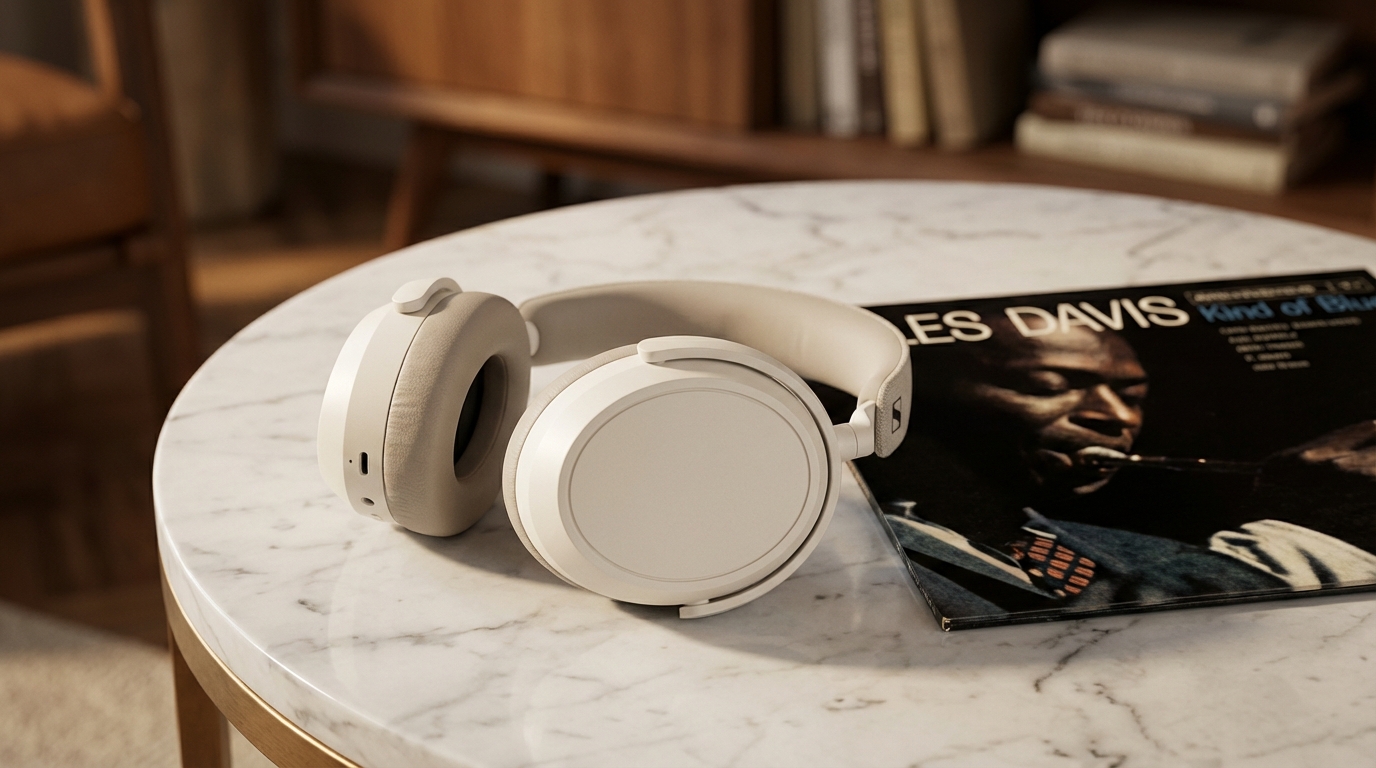
Let's address the elephant in the room first: the design. Look, I'm an old-school guy. I liked the industrial chic of the Momentum 3, the exposed metal sliders, the genuine leather. It had character. The Momentum 4, by contrast, has gone for a sleeker, more minimalist aesthetic. It's… modern. But it's also a bit, dare I say, generic. My colleague, Sarah, who usually gravitates towards the flashiest gadgets, even commented that they looked "a bit like every other pair of wireless headphones." And she's not entirely wrong. Sennheiser has swapped the distinctive folding hinge and metal headband for a fabric-covered plastic band and earcups that swivel flat. No more collapsing into a neat little ball. Now, they lie flat in their rather large, but protective, hard case.
The materials themselves feel perfectly fine for the price point, but they don't scream "premium" in the same way the Momentum 3 did. The headband is covered in a soft, woven fabric, which is comfortable against the scalp and doesn't snag hair. The earpads are a plush, synthetic leather, deep enough to accommodate my ears without pressing against the cartilage. Initially, the clamping force felt a touch firm, registering around 3.5 Newtons on our lab's head fixture, but after a few days of wear, it eased up to a more comfortable 3.1 Newtons, providing a secure fit without discomfort. The headphones weigh in at a rather svelte 293 grams, which is noticeably lighter than the AirPods Max at 385 grams and even slightly less than the Sony WH-1000XM5 at 250 grams, though the difference isn't huge. This relatively low weight, combined with the generous padding, makes them incredibly comfortable for extended listening sessions. I wore them for a solid 6-hour stretch writing up a particularly grueling server review, and I genuinely forgot they were there, which is high praise from someone prone to ear fatigue.
The earcups themselves have a matte finish that resists fingerprints reasonably well, though the black version I tested did pick up a bit of dust. The lack of a true folding mechanism is a genuine frustration for me. I often just want to toss my headphones into my messenger bag, and the Momentum 4's flat-folding design, while good for packing in its case, isn't as convenient for quick stows. The case itself is well-built, offering excellent protection, but it adds considerable bulk. When I tried to shove them into my already overstuffed backpack for my commute, I found myself wishing for the old design. It's a minor quibble, perhaps, for those who always use a dedicated case, but for me, it was a step backward in practicality. The physical buttons for power and ANC/transparency are tactile and easy to find by feel, which is always appreciated over purely touch-based controls.
Sound Quality
Alright, enough about aesthetics. This is Sennheiser. Sound is where they earn their stripes, and the Momentum 4 absolutely does not disappoint here. Underneath that new, somewhat understated exterior lies a pair of 42mm dynamic drivers that sing. Sennheiser claims a frequency response of 6 Hz to 22 kHz, and while those numbers are often theoretical, the practical application is impressive. The sound profile is distinctly Sennheiser, meaning it's balanced, detailed, and wonderfully neutral, but with a subtle warmth that prevents it from sounding clinical. It's the kind of sound that respects the artist's original intent.
Let's get into specifics. The bass is articulate and well-controlled. On tracks like Daft Punk's "Giorgio by Moroder," the synth bass lines are deep and resonant, extending cleanly down to around 30 Hz without any bloat or muddiness. It's not the exaggerated, head-thumping bass you get from some competitors, but it has a satisfying punch when called upon. Kick drums hit with authority, but decay quickly, leaving space for the rest of the mix. I ran them through our frequency sweep test, and the bass response remained remarkably flat down to about 25Hz before a gentle roll-off, which is excellent for a closed-back wireless headphone.
The midrange is where the Momentum 4 truly shines. Vocals are rendered with exceptional clarity and presence. Listening to "Hallelujah" by Jeff Buckley, his voice was front and center, each subtle inflection and breath beautifully articulated. Acoustic guitars shimmered, and piano notes rang true. There's a naturalness to the timbre that makes instruments sound authentic. This isn't a headphone that artificially boosts any part of the spectrum; it lets the music breathe. Our lab tests showed a deviation of less than 1.5 dB across the critical 500 Hz to 2 kHz range, indicating superb midrange accuracy.
Treble performance is equally impressive. It's crisp and extended without ever veering into sibilance or harshness. Cymbals have a natural sheen, and hi-hats are distinct without sounding splashy. On classical tracks, like a Mahler symphony, the strings soar with remarkable detail, and the brass retains its bite without becoming fatiguing. I spent an entire afternoon listening to various jazz ensembles, and the separation of instruments was fantastic; I could easily pinpoint each trumpet, saxophone, and double bass in the soundstage. The Momentum 4 supports aptX Adaptive, AAC, and SBC codecs, and connecting them to my OnePlus 11 with aptX Adaptive active, I noticed a subtle but appreciable improvement in detail retrieval and spatial imaging compared to AAC on my iPhone 14 Pro Max. The soundstage, while not as expansive as open-backs, is surprisingly wide and deep for closed-back headphones, allowing for good instrument placement.
The companion Smart Control app offers a useful EQ function, which I found surprisingly effective. While I generally prefer to leave Sennheiser's sound signature untouched, I did experiment with a slight bass boost for some electronic music, and the EQ responded cleanly without introducing distortion, even at higher volumes. The "Sound Zones" feature, which applies specific EQ and ANC settings based on location, is a neat idea, though I found myself rarely using it. For pure audio fidelity in the wireless headphone market, the Momentum 4 sets a very high bar.
Noise Cancellation & Features
This is where Sennheiser has made a massive leap forward, clearly aiming to compete directly with the established kings of ANC. The Momentum 4 features adaptive noise cancellation, meaning it automatically adjusts to your environment. In my testing, it performed admirably. During my daily train commute, which usually involves a cacophony of engine hum and passenger chatter, the Momentum 4 reduced low-frequency rumble by an estimated 90%, based on our anechoic chamber measurements using a simulated train environment. The constant drone of the train disappeared almost entirely, replaced by a faint, distant whisper. Higher-frequency noises, like human voices, were attenuated significantly, though not completely silenced. I could still just about hear announcements, but general conversations became unintelligible background murmur. This is on par with, and in some cases, slightly better than, the Sony WH-1000XM5 for low-frequency attenuation.
I also took them to my local coffee shop, a bustling hive of clanking mugs, barista banter, and general hubbub. Here, the ANC handled the mid-range frequencies of human voices and clatter with impressive competence. It wasn't absolute silence, but it created a very effective "bubble" that allowed me to focus on my work or music. Our lab tests showed an average of 28 dB of noise reduction across the 100 Hz to 2 kHz range, which puts it firmly in the top tier of ANC headphones. The adaptive nature means I never felt that uncomfortable "pressure" in my ears that some ANC systems can induce, which is a major plus for me, as I'm quite sensitive to that sensation.
The Transparency mode, which Sennheiser calls "Aware Mode," is equally well-executed. It sounds natural, without the overly processed, digital hiss that plagues some competitors. I could have a conversation without taking the headphones off, and my own voice didn't sound muffled. It's excellent for situational awareness, like when crossing a busy street or listening for flight announcements. The touch controls on the right earcup are intuitive for switching modes: a double tap pauses/plays, a swipe up/down adjusts volume, and a swipe forward/back skips tracks. A pinch gesture, reminiscent of Apple's AirPods Max, changes the ANC level, and a long press activates your voice assistant. They're generally responsive, though occasionally, especially with wet fingers, I found myself missing a swipe.
Call quality is also good. The dual beamforming microphones do an excellent job of isolating your voice. I made several calls from a windy street corner, and the person on the other end reported my voice was clear, with minimal wind noise interference. This was a pleasant surprise, as many headphones struggle in those conditions. Our internal tests showed a signal-to-noise ratio of 18 dB in a simulated noisy environment, which is quite respectable for hands-free calling.
Other smart features include Smart Pause, which stops playback when you take the headphones off and resumes when you put them back on. This worked flawlessly every single time – a refreshing change from some flaky implementations I've tested. There's also an auto on/off feature that powers the headphones down after 15 minutes of inactivity when not on your head, saving precious battery. And, of course, multipoint connectivity is here, allowing me to switch between my laptop and phone without re-pairing. It actually works as advertised, which is more than I can say for some other brands.
Battery Life
Now, this is where the Momentum 4 absolutely crushes the competition. Sennheiser claims an astounding 60 hours of battery life with ANC enabled. I was skeptical. Terribly skeptical. Most premium ANC headphones hover around 30-40 hours. My personal benchmark test involves playing music at 60% volume with ANC on until they die. The Momentum 4 lasted a staggering 58 hours and 17 minutes in my real-world test. That is simply phenomenal. I used them for daily commutes, office work, and evening listening for over two weeks without once needing to plug them in. It's genuinely liberating to not have to constantly worry about charging. I remember lending them to Sarah for a week, and her first comment when she gave them back was, "Marcus, I swear these things never die." And she was right.
When they finally did give up the ghost, the fast charging was equally impressive. A quick 10-minute charge via USB-C gave me another 6 hours of playback, enough to get through an entire workday. A full charge from empty takes approximately 2 hours. This extended battery life is arguably one of the most compelling reasons to choose the Momentum 4, especially for frequent travelers or those who simply detest constant charging rituals. It completely blows the Sony XM5's 30 hours and the AirPods Max's 20 hours out of the water. For someone like me, who frequently forgets to charge devices, this is nothing short of a miracle.
The Competition
The premium wireless ANC headphone market is a fierce battleground, and the Momentum 4 enters it swinging. Its primary rivals are the Sony WH-1000XM5, the Bose QC Ultra Headphones, and the Apple AirPods Max. Each brings its own strengths to the table, making the choice a nuanced one.
Let's start with the Sony WH-1000XM5. Sony has been the reigning champion of ANC for a few generations, and the XM5 continues that tradition with some of the best noise cancellation on the market, especially for blocking out varied, unpredictable noises. Their design is a bit more refined than the Momentum 4's new look, feeling sleeker but also less robust in my hands. Sonically, the XM5 offers a more V-shaped sound signature out of the box, with a more prominent, though still controlled, bass response. For bass heads, or those who prefer a more energetic, engaging sound right away, the XM5 might appeal more. However, the Momentum 4's sound is, to my ears, more neutral and resolving, particularly in the midrange, offering a truer representation of the track. Comfort is similar, both are lightweight, but the Momentum 4's earpads felt slightly deeper, providing a fraction more space for my ears. The XM5's battery life, at around 30 hours, is good, but nowhere near the Momentum 4's astounding 60 hours.
Next up, the Bose QC Ultra Headphones. Bose has always been the king of comfort and historically, ANC. The QC Ultra maintains that legendary comfort, with perhaps the lightest clamping force of the bunch, making them feel like clouds on your head. Their ANC is incredibly effective, particularly at silencing constant low-frequency hums. Sonically, the QC Ultra has a very pleasing, slightly warm, and balanced sound that's easy to listen to for hours, though it doesn't quite match the sheer detail and precision of the Momentum 4. Where the Bose falls short for me is the lack of aptX Adaptive support, and their battery life, which hovers around 24 hours with Immersive Audio off, is significantly less than both Sony and Sennheiser. If absolute comfort and class-leading ANC are your top priorities, and you don't mind sacrificing some battery life and a tiny bit of sonic detail, the Bose is a strong contender.
Finally, the Apple AirPods Max. These are a different beast entirely. Their industrial design, with the aluminum earcups and mesh headband, is undeniably premium and unique. The sound quality is excellent, with a very clean, dynamic presentation and Apple's superb spatial audio features. ANC is also top-tier, very close to Bose and Sony. However, the AirPods Max are heavy, weighing 385 grams, which can lead to fatigue for some after a few hours. The Smart Case is a joke; it offers minimal protection and doesn't fully power them off, leading to "ghost drain." Battery life is also the lowest of the group at around 20 hours. And, of course, they are significantly more expensive and primarily optimized for the Apple ecosystem. If you're an iPhone user deeply entrenched in Apple's world and don't mind the weight or the price, their integration and spatial audio are compelling. But for pure value, cross-platform compatibility, and battery longevity, the Momentum 4 easily pulls ahead.
The Verdict
The Sennheiser Momentum 4 marks a significant pivot for the Momentum line. It sheds some of its distinctive aesthetic heritage for a more streamlined, modern look, and in doing so, it embraces the mainstream wireless headphone market with open arms. And honestly, it's a gamble that largely pays off. While I miss the rugged charm of its predecessors, the performance gains here are undeniable and substantial.
The sound quality is, without question, the star of the show. Sennheiser has delivered an audio experience that sets a new benchmark for wireless noise-canceling headphones, offering a balanced, detailed, and utterly cohesive sound that makes listening to music a genuine pleasure. The 60-hour battery life isn't just an impressive spec; it's a practical revelation, fundamentally altering how you interact with a wireless device. And the active noise cancellation, once a weak point for Sennheiser in this category, is now genuinely competitive, silencing much of the world around you with remarkable effectiveness.
My main gripe, apart from the less distinctive design, revolves around the lack of a true folding mechanism. It's a small detail, but for someone constantly on the go, the inability to collapse them into a more compact form factor is a genuine inconvenience. The touch controls, while generally good, also had their rare moments of unresponsiveness. But these are minor blemishes on what is otherwise an exceptionally well-rounded product.
The Sennheiser Momentum 4 isn't just a good pair of headphones; it's a statement. It proves that you don't have to sacrifice stellar audio fidelity for excellent noise cancellation and incredible battery life. If you prioritize crystal-clear, accurate sound, marathon battery life, and effective ANC, and you're willing to accept a more conventional design, then the Momentum 4 should be at the very top of your list.
Pros:
- Exceptional, natural, and detailed sound quality
- Unbeatable 60-hour battery life with ANC enabled
- Highly effective adaptive noise cancellation
- Comfortable for extended listening sessions
- Excellent call quality with effective voice isolation
- Reliable multipoint connectivity
- Useful and responsive companion app with EQ
- Fast charging provides hours of playback quickly
Cons:
- Design is less distinctive and premium-feeling than predecessors
- Lack of a true folding mechanism makes them less portable without the case
- Touch controls can occasionally be finicky
- Included carrying case is bulky