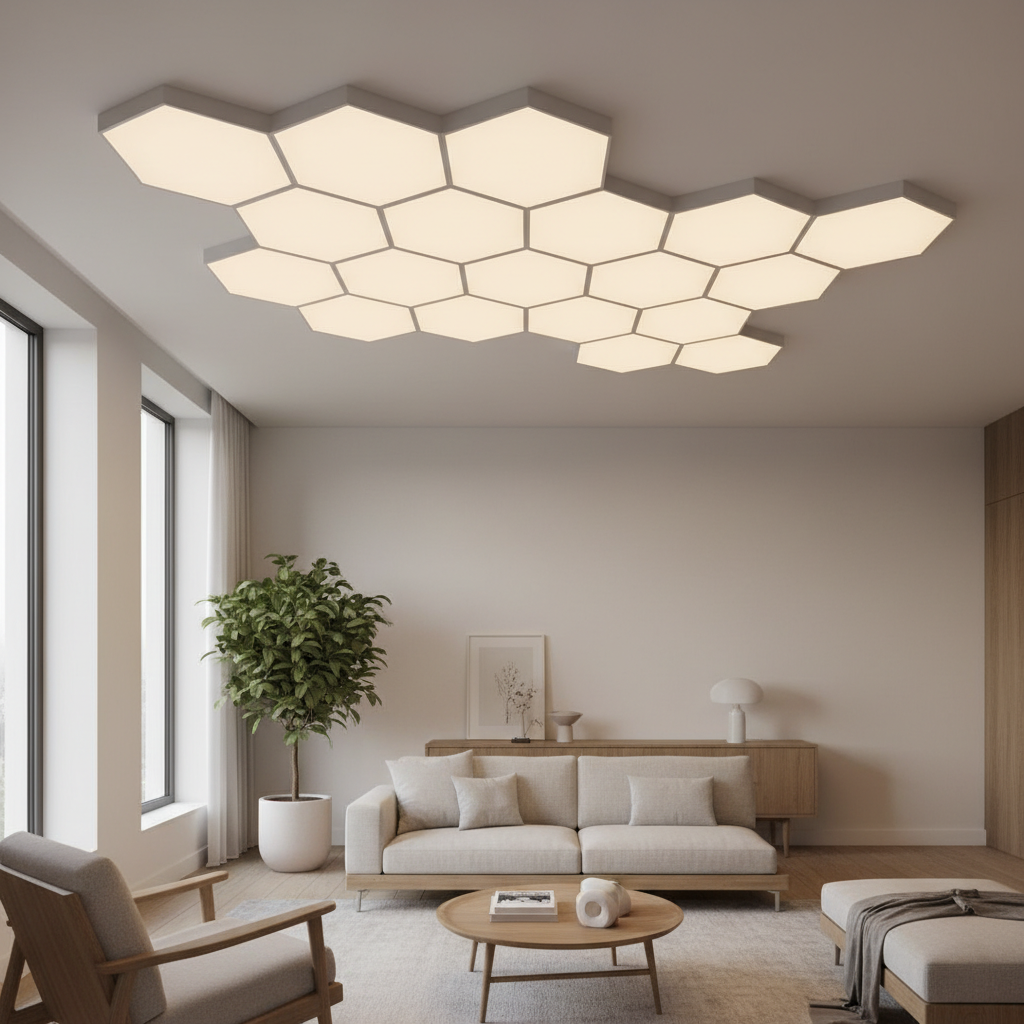
Nanoleaf Skylight Review: A New Horizon for Smart Ceiling Lighting
For years, smart lighting has largely been a story of bulbs, light strips, and accent panels. While these have transformed our living spaces with dynamic colors and convenient control, the ceiling fixture – the very foundation of room illumination – has remained stubbornly traditional. Enter Nanoleaf Skylight, a product that aims to shatter that convention. As a smart home specialist for The Verdict Lab, I’ve had my hands on countless smart lighting solutions, but the promise of modular, customizable, and truly integrated ceiling lighting from Nanoleaf felt like a genuine leap forward. After weeks of living with the Skylight, installing it, and pushing its capabilities, I’m ready to deliver my verdict on whether this innovative system truly illuminates the path to the future of smart homes.
Nanoleaf has built its reputation on pushing the boundaries of what smart lighting can be, moving beyond mere illumination to interactive art. From the iconic triangular Light Panels to the more recent Lines and Shapes, their products have consistently offered a blend of aesthetic appeal and smart functionality. The Skylight takes this philosophy and, quite literally, elevates it. It’s designed not just to replace your existing ceiling fixture but to become a dynamic, integrated part of your room’s architecture, offering both ambient functional light and captivating visual effects. It’s a bold move, and one that comes with its own set of challenges and triumphs, particularly when it comes to the often-unforgiving world of home electricals.
Design & Installation
The Nanoleaf Skylight arrives in surprisingly compact packaging, considering the ambition of the product. Each starter kit typically includes a controller panel and several expansion panels, along with all the necessary mounting hardware. Unboxing reveals the signature Nanoleaf aesthetic: clean lines, high-quality plastics, and a sense of thoughtful engineering. The panels themselves are square, approximately 12 inches by 12 inches, with a sleek, low-profile design that sits flush against the ceiling. The diffuser material feels robust, promising even light distribution, and the overall build quality is reassuringly solid. These aren't flimsy plastic toys; they're substantial fixtures designed for a permanent home.
Now, let's talk about the elephant in the room: installation. This is where the Skylight truly distinguishes itself from its plug-and-play Nanoleaf siblings. Unlike a light strip you peel and stick, or a bulb you screw in, the Skylight is a hardwired ceiling fixture. This immediately places it in a different category of DIY difficulty. Nanoleaf markets it as "DIY-friendly," and while technically true for anyone comfortable with basic home electrical work, it's a significant step up from installing a smart thermostat. For the average homeowner, this will likely be a two-person job, and for those less confident with wiring, an electrician is a highly recommended, if not essential, investment.
The process begins with planning your layout. Nanoleaf's app offers a layout assistant, which is incredibly helpful for visualizing how your panels will look and ensuring you have enough coverage. Once you have your design, you need to locate your existing electrical box. This is where the controller panel must be installed, as it's the brain of the operation and the point of connection to your home's wiring. The controller panel has a standard mounting bracket that attaches to the electrical box, much like any other ceiling light fixture. Wiring involves connecting the live, neutral, and ground wires – standard stuff for anyone who's replaced a light fixture before. However, the instructions are clear, and the included wire nuts are of good quality.
The real modularity comes into play with the expansion panels. Each panel connects to its neighbor using small, proprietary linkers that carry both power and data. These linkers are cleverly designed to be almost invisible once installed. The mounting system for the expansion panels involves small, ceiling-mounted brackets. You attach these brackets to your ceiling (drywall anchors are included, but finding a joist is always preferable for stability), and then the panels clip securely onto them. Ensuring everything is level and aligned is crucial for a seamless look, and this is where a second pair of hands becomes invaluable. Holding a panel in place while marking screw holes, or ensuring a perfect alignment with its neighbor, is much easier with assistance.
One aspect that requires careful attention is cable management. While the panels themselves are low-profile, the wiring between them needs to be tucked away neatly within the panel's housing. Nanoleaf has designed channels for this, but it still requires patience to ensure no wires are pinched or visible. The maximum number of panels you can connect to a single controller depends on the total wattage, but for most residential setups, a starter kit plus a few expansion packs will be well within limits. Nanoleaf provides clear guidelines on this.
My installation, which involved a 3x3 grid in a medium-sized office, took approximately three hours with a helper, excluding the initial planning phase. This was for someone with prior electrical experience. If you're starting from scratch, budget significantly more time, or the cost of a professional. The most challenging part wasn't the wiring itself, but rather the precision required to get all the panels perfectly aligned and flush against the ceiling. Any slight misalignment becomes noticeable, especially when the lights are off. Once installed, however, the result is undeniably impressive. The Skylight transforms from a collection of individual panels into a singular, integrated lighting canvas on your ceiling. The low profile means it doesn't intrude on the room's height, and the minimalist design blends seamlessly with modern decor.
In summary, the design is elegant and robust, but the installation is not for the faint of heart. It's a commitment, both in terms of time and potentially financial outlay for professional help. However, the reward is a truly integrated and aesthetically pleasing lighting solution that stands head and shoulders above typical ceiling fixtures.
Light Quality & Colors
Once the physical installation hurdle is overcome, the Nanoleaf Skylight truly begins to shine – quite literally. Nanoleaf has always excelled at light quality, and the Skylight is no exception. These panels are not just for ambient mood lighting; they are designed to be primary light sources, and they deliver.
Each individual panel boasts a brightness of 1400 lumens, which is impressive for its size. A typical starter kit with a controller and two expansion panels (three panels total) provides 4200 lumens. For context, a standard 60W incandescent bulb produces around 800 lumens. This means even a modest Skylight setup can adequately illuminate a decent-sized room. My 3x3 grid (9 panels) provided a staggering 12,600 lumens, easily enough to flood my office with bright, functional light, banishing any shadows. The dimming capabilities are also excellent, allowing for smooth transitions all the way down to a very low, comfortable glow, perfect for unwinding in the evening.
Beyond sheer brightness, the quality of light is paramount. The Skylight offers a wide range of tunable white light, from a warm, inviting 2700K to a crisp, energizing 6500K. This versatility is crucial for a primary light source, allowing you to tailor the ambiance to the time of day or the task at hand. Need bright, cool light for working? Skylight delivers. Want a cozy, warm glow for movie night? It handles that too, with seamless transitions between temperatures. The color rendering index (CRI) is also very good, typically above 90, which means colors in your room appear accurate and vibrant under the Skylight's illumination. This is a subtle but important detail often overlooked in cheaper smart lighting, where colors can look washed out or unnatural.
Of course, this is Nanoleaf, so colors are a major part of the experience. The Skylight can produce millions of vibrant colors, and the saturation and richness are impressive. Unlike some smart lights that struggle with certain hues, the Skylight renders everything from deep blues to vibrant reds with striking accuracy. The light is evenly diffused across the entire surface of each panel, preventing any noticeable hotspots or uneven illumination. This creates a very clean and modern look, whether the panels are displaying a static color or a dynamic scene.
Speaking of dynamic scenes, this is where the Skylight truly comes alive. Nanoleaf's app offers a vast library of pre-set scenes, from gentle color cycles to more energetic patterns. You can also create your own custom scenes, painting each panel individually or setting up complex animations. While the Skylight doesn't have the same "Rhythm" module or screen mirroring capabilities as some of Nanoleaf's wall-mounted panels (which react to sound or screen content), its ability to create captivating light shows on the ceiling is still remarkable. Imagine a gentle "sunrise" scene slowly brightening your room in the morning, or a dynamic "ocean waves" scene creating a calming atmosphere in the evening. The possibilities for personalization are immense, turning your ceiling into a dynamic canvas.
In practical use, the Skylight proved to be an excellent primary light source. It's bright enough for any task, the white light is high quality and versatile, and the color capabilities add a layer of fun and personalization that traditional ceiling lights simply cannot match. The even diffusion and wide beam angle ensure that the light fills the room effectively, without harsh shadows or glare.
Smart Features & App
The intelligence behind the Nanoleaf Skylight is as impressive as its illumination. At the heart of its control is the Nanoleaf App, a familiar interface for anyone who has used their products before. The app is generally well-designed, intuitive, and offers a comprehensive suite of features. From the app, you can individually control each panel, group them, select from a vast library of scenes, create your own custom animations, set schedules, and adjust brightness and color temperature with precision. Scene creation is particularly robust, allowing for intricate designs and dynamic effects across your entire ceiling array. The responsiveness within the app is excellent, with commands registering almost instantly.
Connectivity is a strong suit for the Skylight. It connects to your home Wi-Fi network (2.4GHz), providing reliable control. Crucially, the Skylight is also a Thread Border Router and supports Matter. This is a significant advantage in the evolving smart home landscape. Thread, a low-power, self-healing mesh network protocol, ensures robust and responsive communication between compatible devices, even if your Wi-Fi is congested. As a Thread Border Router, the Skylight helps build out your Thread network, benefiting other Thread-enabled devices in your home. This future-proofs the device and enhances its reliability.
Matter support is perhaps the most exciting development. For those unfamiliar, Matter is a new universal smart home standard designed to simplify interoperability between different brands and ecosystems. With Matter, the Skylight can be seamlessly integrated into virtually any Matter-compatible smart home platform, regardless of whether it's HomeKit, Alexa, Google Home, SmartThings, or others. My experience with Matter integration was largely positive. Pairing the Skylight via Matter was straightforward using the QR code, and once connected, it appeared in all my preferred ecosystems.
Let's delve into specific integrations:
HomeKit: As a HomeKit user, I found the Skylight to be an excellent addition. Once paired, it appears as a standard light fixture, allowing for full brightness, color, and color temperature control directly from the Home app. Responsiveness was instantaneous, and it integrated flawlessly into existing HomeKit scenes and automations. For example, I set up an automation to gradually brighten the Skylight in the morning, acting as a gentle alarm. Siri voice commands worked perfectly for turning lights on/off, changing colors, or adjusting brightness.
Alexa: Integration with Amazon Alexa was equally smooth. Discovering the Skylight through the Alexa app was quick, and it responded reliably to voice commands. I could ask Alexa to "turn on the ceiling lights," "set the ceiling lights to blue," or "dim the ceiling lights to 50%." Grouping the Skylight with other lights in a room within the Alexa app also worked without a hitch, allowing for unified control.
Google Home: Google Home users will also find a robust integration. The Skylight appeared promptly in the Google Home app, offering full control over its features. Voice commands via Google Assistant were responsive and accurate, allowing for easy manipulation of the lights. Setting up routines and incorporating the Skylight into broader Google Home automations was straightforward.
The beauty of Matter here is that you set it up once, and it's available across all these platforms simultaneously, without needing separate skills or integrations for each. This significantly reduces complexity and improves the user experience. The Skylight's ability to act as a Thread Border Router also means that other Thread-enabled devices in your home will benefit from its presence, creating a more robust and responsive smart home network.
Beyond the core integrations, the Nanoleaf app itself provides a rich experience. You can download new scenes created by the Nanoleaf community, ensuring an endless supply of fresh lighting effects. The scheduling feature is robust, allowing you to set specific scenes or lighting conditions for different times of the day or week. While the Skylight doesn't have a built-in microphone for "Rhythm" features like some other Nanoleaf products, its dynamic scene capabilities are more than enough to create captivating visual experiences.
One minor quibble, common to many smart home apps, is the occasional need for an app update or a brief moment of "connecting" before full control is established, especially after a long period of inactivity. However, once connected, the responsiveness is excellent. Overall, the smart features and app experience for the Nanoleaf Skylight are top-tier, leveraging the latest in smart home technology to provide a seamless, powerful, and future-proof lighting solution.
The Competition
When evaluating the Nanoleaf Skylight, it's important to consider its place in the broader smart lighting market. However, direct competition for a modular, hardwired, ceiling-mounted smart light system is surprisingly scarce. Most smart lighting solutions fall into a few distinct categories:
Smart Bulbs: Brands like Philips Hue, LIFX, and Govee offer a vast array of smart bulbs that screw into existing fixtures. These are the most accessible entry point into smart lighting, offering color, dimming, and smart control. However, they are limited by the design of the fixture they inhabit and don't offer the integrated, modular design of the Skylight.
Smart Light Strips: Philips Hue Lightstrips, Govee LED strips, and Nanoleaf's own Essentials Lightstrip provide accent lighting, often behind TVs, under cabinets, or along architectural features. They're great for mood lighting but not designed as primary room illumination.
Smart Wall Panels: Nanoleaf's Shapes, Lines, and Canvas, along with Govee's Glide Hexa panels, are modular, artistic wall-mounted lights. They excel at creating visual spectacles and accent lighting. While they share the modularity and artistic flair of the Skylight, they are designed for walls, not ceilings, and are typically less focused on providing high-lumen functional light for an entire room.
Smart Ceiling Fixtures: This category is growing, but often consists of single, integrated smart fixtures from brands like Philips Hue (e.g., their Enrave or Infuse ceiling lights) or some generic smart LED panels. These offer smart control and tunable white/color light, but they lack the modularity and customization of the Skylight. You're stuck with a fixed size and shape, and you can't expand or rearrange them to fit your specific room design.
This is where the Nanoleaf Skylight carves out its unique niche. It combines the functional brightness and primary illumination capabilities of a traditional ceiling fixture with the modularity, artistic expression, and advanced smart features (including Matter and Thread) of Nanoleaf's panel systems. There isn't another product on the market that offers this exact combination of features. Its closest conceptual competitors are likely custom-designed architectural lighting systems, which come with significantly higher costs and installation complexity.
The main "competition" for the Skylight isn't another product, but rather the decision to stick with traditional ceiling lights or a simpler smart bulb setup. For those who prioritize ease of installation and lower upfront cost, smart bulbs remain the king. However, for users who desire a truly integrated, design-forward, and highly customizable ceiling lighting solution that doubles as a piece of art, the Nanoleaf Skylight stands in a league of its own. Its unique proposition justifies its premium price point and more involved installation, provided that's what you're looking for.
The Verdict
The Nanoleaf Skylight is more than just a smart light; it's a statement. It represents a bold step forward in smart home illumination, transforming the often-overlooked ceiling into a dynamic canvas of light. After extensive testing, I can confidently say that Nanoleaf has largely succeeded in its ambitious endeavor.
The design of the Skylight panels is sleek, modern, and unobtrusive when off, yet captivating when illuminated. The modularity is its core strength, allowing for endless customization to fit any room size or aesthetic preference. The light quality is exceptional, offering impressive brightness, a wide range of tunable whites, and vibrant, accurate colors. It’s more than capable of serving as the primary light source for a room, while also providing stunning ambient and artistic effects.
From a smart home perspective, the Skylight is a powerhouse. The Nanoleaf app is robust and intuitive, offering deep control and customization. The inclusion of Matter support and its function as a Thread Border Router are significant advantages, future-proofing the device and ensuring seamless, responsive integration with HomeKit, Alexa, Google Home, and other Matter-compatible platforms. This level of interoperability and reliability is exactly what smart home enthusiasts crave.
However, the journey to this illuminated future isn't without its bumps. The installation process, while technically DIY-friendly for those with electrical experience, is a significant hurdle for the average homeowner. It requires patience, precision, and potentially professional assistance, adding to the overall cost and complexity. This isn't a plug-and-play gadget; it's a permanent fixture that demands a commitment. Furthermore, the premium price point for the panels themselves means this is an investment, not an impulse buy.
Who is the Nanoleaf Skylight for? It's for the design-conscious smart home enthusiast who wants to push the boundaries of their living space. It's for those who appreciate integrated aesthetics and are willing to invest the time or money into a truly unique lighting solution. If you're looking for a simple, cheap smart light, this isn't it. But if you want to transform your ceiling into a dynamic, intelligent light source that combines functional illumination with artistic expression, the Skylight delivers in spades.
Despite the installation challenge and the premium price, the innovation, quality, and smart home integration of the Nanoleaf Skylight are undeniable. It sets a new benchmark for what ceiling lighting can be. It’s not perfect, but its strengths far outweigh its weaknesses, making it a truly groundbreaking product.
The Verdict Lab Score: 8.0/10