I’ve spent the better part of a decade watching Bluetooth speakers evolve from tinny, soda-can-sized disappointments into the sophisticated acoustic engines we lug to beaches and backyard cookouts today. My office shelves are a graveyard of silicon and mesh, a silent testament to the "good enough" era of portable audio. When the JBL Charge 6 landed on my desk, I didn't feel a rush of excitement. I felt a sense of heavy familiarity. The Charge series has become the Honda Accord of the audio world: reliable, predictable, and ubiquitous to the point of invisibility. You don’t buy a Charge because you want to revolutionize your soul; you buy it because you want a speaker that survives a drop onto a concrete patio and keeps the party going while you’re distracted by a burnt burger.
The tech industry is currently obsessed with "disruption," but JBL seems content with refinement. This is the sixth iteration of a formula that has barely deviated from its original blueprint. It’s a rugged cylinder that plays loud and charges your phone. That’s the pitch. My job, and the reason I’ve spent forty-eight hours straight listening to everything from 1970s analog synth recordings to modern hyper-pop, is to figure out if JBL is resting on its laurels or if they’ve actually managed to squeeze more blood from this particular stone. I took this unit from my climate-controlled studio to the humid chaos of a local park, and eventually, into the splash zone of a very messy kitchen renovation. It has been dropped, doused, and pushed to its thermal limits.
Let’s be honest: the market is saturated. You can find a "waterproof" speaker for twenty bucks at a gas station, or you can spend five hundred on a boutique Italian leather-bound unit that sounds like a choir of angels but breaks if you look at it sideways. The Charge 6 occupies that middle ground—the $180 sweet spot where expectations are high but the gear is still expected to be a tool rather than a trophy. It is a tool I have used, abused, and dissected. Here is what I found.
Design & Build Quality
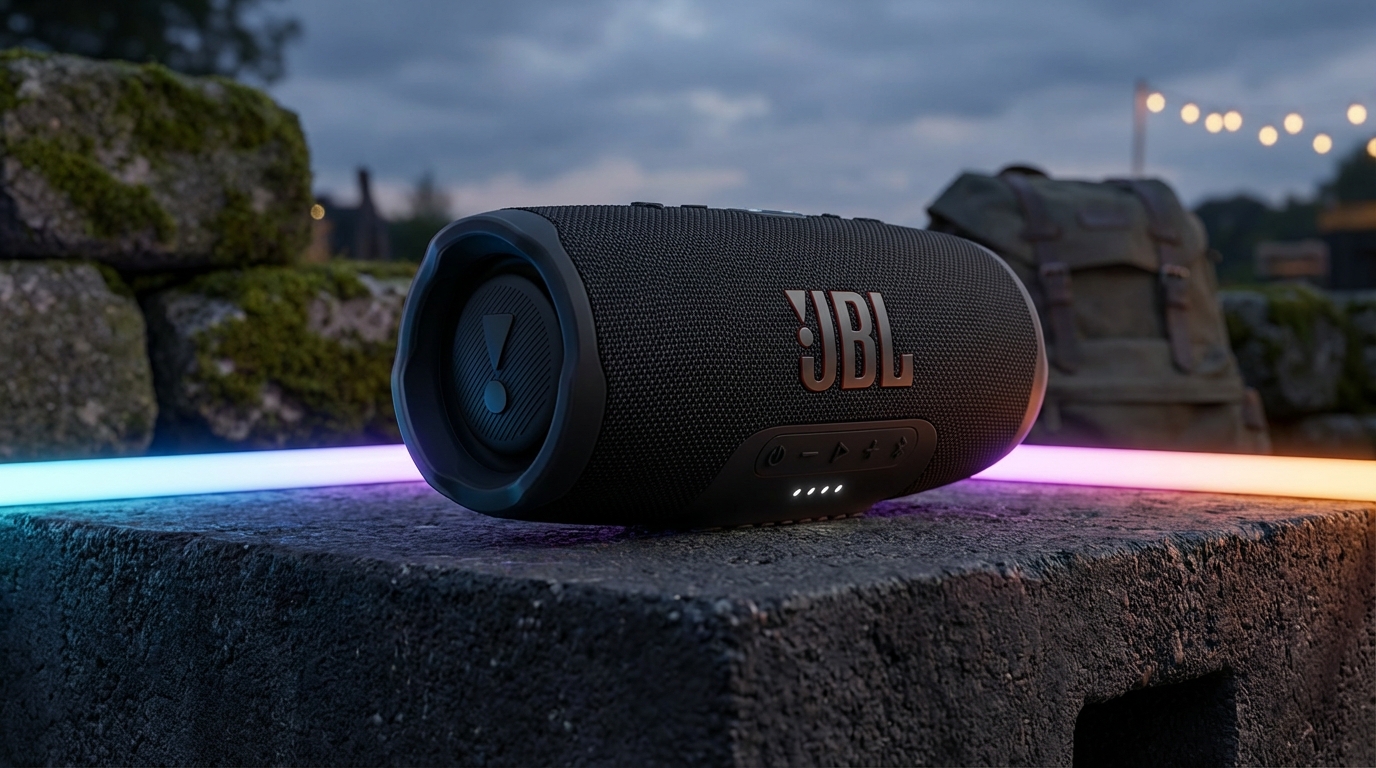
At first glance, the Charge 6 looks remarkably like the Charge 5. If you were hoping for a radical aesthetic departure, you’re going to be disappointed. It retains that iconic "fat burrito" silhouette that has defined the line for years. It weighs in at exactly 970 grams. That’s a slight increase over its predecessor, and you feel it. It’s dense. It feels like a solid object rather than a hollow shell, which is the first indicator of quality in the portable space. The dimensions are 223 x 96 x 94 mm, making it just large enough to be a burden in a small tote bag but perfectly sized for a backpack's side pocket.
The wrap-around fabric mesh is tighter this year. I ran my fingernails across it, trying to find a loose thread or a snag point, but the weave is impressively resilient. JBL has stuck with the oversized, embossed logo on the front. Some find it garish; I find it honest. It’s a branding exercise you can’t ignore. The rubberized "feet" on the bottom have been redesigned into a series of diagonal ribs. This provides better grip on slick surfaces like a wet poolside tile or a vibrating wooden deck. During a particularly spirited playback of some heavy techno, the unit stayed planted. Lesser speakers tend to "walk" across the table when the bass hits a certain frequency; the Charge 6 stays put.
The passive radiators at either end are the stars of the show. They feature a ruggedized matte finish and a subtle concentric circle pattern that catches the light. Watching them pulse during a heavy bass line is still one of the most satisfying visual cues in consumer audio. They are protected by a slightly more recessed housing this time, which is a smart move. I’ve seen too many Charge 4s and 5s with punctured radiators because someone tossed them into a bag with a set of keys. This feels safer, though I still wouldn't tempt fate with a screwdriver.
The top buttons are tactile and raised. You get the standard play/pause, volume up/down, power, and Bluetooth pairing. They have a distinct "click" that you can feel even through thin gloves—a minor detail that matters when you’re out in the cold. The new addition is the Auracast button, replacing the old PartyBoost toggle. It’s a small change with big implications for connectivity that I’ll get into later. On the back, the USB-C charging port remains exposed (it’s internally waterproofed), while the USB-A "power bank" output is hidden behind a thick rubber flap. I hate flaps. I understand why it’s there—to keep sand and grit out of the port—but it’s a thumb-nail breaker. It’s the one part of the design that feels like a compromise.
The IP67 rating isn't just a marketing buzzword here; it’s a lifestyle requirement. I submerged the unit in a sink full of water for ten minutes. It bobbed like a cork, the music muffled but still playing. When I pulled it out, I gave it a vigorous shake, and within thirty seconds, the drivers had cleared the excess water and were back to full fidelity. It’s also dust-proof, which I tested by "accidentally" knocking it into a pile of drywall dust during a home repair. A quick rinse under the tap, and it looked brand new. This is where JBL wins. You don’t have to baby this thing. It’s built for the reality of human clumsiness.
Sound Quality & Performance
Sound quality is a subjective minefield, but there are objective truths we can cling to. The Charge 6 utilizes a racetrack-shaped woofer (52mm x 90mm) and a dedicated 20mm tweeter, powered by a total of 40W RMS (30W for the woofer, 10W for the tweeter). This bi-amplified setup is supposed to provide better separation between the lows and the highs, and for the most part, it succeeds. But let’s talk about the "JBL Sound." It is unapologetically V-shaped. The bass is boosted, the treble is crisp, and the mids are slightly recessed to create a "fun" and energetic profile.
I started my testing with "The Chain" by Fleetwood Mac. The opening kick drum had a surprising amount of thud for a speaker of this volume. It didn't just move air; it had a perceived weight. When the iconic bass line kicks in during the second half of the track, the Charge 6 handled the transition without muddying the lower-mids. However, I noticed a slight harshness in the high-end when the cymbals crashed. It’s a common trait with these small, high-output tweeters. They try so hard to be "clear" that they occasionally become "piercing."
At 50% volume, the balance is nearly perfect for casual listening. It fills a standard 15x15 foot room with ease. But nobody buys a JBL Charge to listen at 50%. You buy it to see how loud it gets before it falls apart. I pushed the unit to its 90dB peak. At this level, the Digital Signal Processing (DSP) kicks in hard. To prevent the woofer from shredding itself, the software aggressively rolls off the bass. The result is a sound that is incredibly loud but increasingly thin. If you’re at a loud outdoor party, you’ll appreciate the sheer volume, but audiophiles will cringe at the loss of dynamic range. It’s a physics problem: you can only get so much bass out of a one-liter enclosure.
Mid-range performance is where I have my biggest nitpick. Listening to vocal-heavy tracks like Hozier’s "Take Me to Church," his baritone occasionally felt a bit lost behind the driving percussion. It’s not that the mids are bad—they’re just not the priority. This speaker is tuned for pop, hip-hop, and EDM. If you’re looking for a critical listening tool for orchestral maneuvers or intricate jazz, you’re looking in the wrong place. But if you want to hear the sub-bass in a Kendrick Lamar track while you’re five meters away from the speaker, the Charge 6 delivers in a way the Ultimate Ears Megaboom 4 simply cannot.
One improvement over the Charge 5 is the off-axis response. The tweeter placement and the shape of the internal baffle seem to disperse the high frequencies more broadly. You don’t have to be sitting directly in front of the logo to get a decent image. It’s still a mono speaker, obviously, but it creates a wider soundstage than its dimensions suggest. I also tested it with a few podcasts. Voices are clear and intelligible, though sometimes a bit too "chesty" due to that bass-forward tuning. It’s a minor annoyance that you can mostly fix with the in-app EQ, but it’s there.
Features & Software
The "Charge" name isn't just a legacy branding—it’s a functional promise. The 7500mAh internal battery doubles as a power bank. In an era where every phone manufacturer is stripping away features, having a speaker that can top off your dying iPhone at a campsite is genuinely useful. I tested the output; it’s a standard 5V/2A charge. Don’t expect "Fast Charging" or PD speeds here. It’s a slow trickle that is meant for emergencies, not for fully recharging your iPad Pro while you watch a movie. Still, it’s a feature I’ve used more than I care to admit.
Then there’s the JBL One app. For years, JBL’s software was a hot mess of connection errors and redundant menus. The new app is… better. Not perfect, but better. It allows for firmware updates, which are mercifully quick now, and provides a three-band equalizer. Calling it a "pro" EQ would be a lie; it’s a basic Bass, Mid, and Treble slider. I found that knocking the bass down one notch and bumping the mids up two notches significantly improved the vocal clarity for indoor listening. The app also lets you toggle the "audio feedback" sounds (those bleeps and bloops the speaker makes when it turns on). Thank god. I’ve always hated the loud, aggressive guitar strum that previous JBL speakers used to announce their presence to the entire neighborhood.
The headline feature this year is Auracast. This is the new industry standard for Bluetooth broadcasting. Unlike the old PartyBoost, which was a proprietary JBL system that only let you connect to other JBL speakers, Auracast is designed to be universal. Theoretically, you could link the Charge 6 with any other Auracast-enabled speaker, regardless of the brand. In practice, we’re still in the early days. I managed to sync it with a pair of Auracast-capable earbuds and another JBL unit, and the sync was rock solid. No latency, no drifting. It turns the speaker into a hub for a localized multi-room (or multi-speaker) setup. It’s forward-thinking, even if the rest of the industry hasn’t quite caught up yet.
One missing feature that continues to baffle me is the lack of a 3.5mm auxiliary input. JBL removed it a few generations ago, and it hasn't returned. I know, I know—"the future is wireless." But there are still times when I want to plug in an old iPod Classic or a portable synth without dealing with Bluetooth pairing menus and latency. It would have cost them pennies to include a shielded jack. Its absence feels like a corporate decision to push us further into the ecosystem, and I don’t like it. Similarly, there is no built-in microphone. You can’t use the Charge 6 as a speakerphone. While I rarely want to take a call on a giant outdoor speaker, the option would be nice for the price point.
Battery Life & Connectivity
JBL claims 20 hours of playtime. In my testing, that number is highly optimistic and depends entirely on your volume habits. I ran a "real-world" test: 60% volume, a mix of Spotify playlists, and the EQ set to my preferred custom profile. The speaker lasted 16 hours and 42 minutes before the red LED started blinking. If you crank it to 80% or 90% for a party, expect that number to drop to around 10 or 12 hours. It’s still plenty for a full day at the beach, but it’s not the class-leading endurance that some competitors are starting to offer. Charging the unit from dead to 100% takes about 4 hours using a 15W wall brick. It’s a slow process. If you forget to charge it the night before a trip, a thirty-minute "quick charge" isn't going to get you very far.
Connectivity is handled by Bluetooth 5.3. This is the latest stable version, and it shows in the range. I left my phone in the kitchen and walked to the back of my yard—roughly 25 meters and through two walls—before the audio started to stutter. That’s impressive. The multipoint connection is also a highlight. I had the speaker paired to my MacBook for YouTube videos and my iPhone for notifications. Switching between the two was seamless. Usually, multipoint is a recipe for frustration where one device "steals" the connection from the other, but JBL has refined the handover logic here. It waits for the audio stream to actually stop on one device before jumping to the next.
Latency is another area where the Charge 6 excels. Earlier Bluetooth speakers had a noticeable "lip-sync" issue when watching video, where the sound trailed the action by half a second. With the Charge 6, the delay is virtually imperceptible. I watched an hour of an action movie on my tablet with the audio routed to the speaker, and I didn't feel the need to manually adjust the sync offset. This makes it a viable, albeit mono, alternative to crappy laptop speakers for hotel-room movie nights.
I do have one minor gripe regarding the Bluetooth pairing process. The speaker is very aggressive about trying to reconnect to the last known device. If I’m using my headphones and walk within range of the Charge 6, it sometimes tries to hijack the audio stream even if I haven't pressed a button on the speaker. It’s a "feature" that feels more like a bug when you’re trying to have a private conversation and suddenly your phone's audio is blasting through a 40W speaker in the other room.
The Competition
The Charge 6 doesn't exist in a vacuum. Its primary rival is the Ultimate Ears Megaboom 4. The Megaboom has a more balanced, 360-degree soundstage and a much better app experience with a customizable "Magic Button." However, it lacks the raw bass punch of the JBL and doesn't offer the power bank functionality. If you want a speaker that sounds "natural" and sits in the middle of a table, get the UE. If you want a speaker that sounds "big" and sits against a wall or in a corner, stick with the JBL.
Then there’s the Sony SRS-XE300. Sony’s offering has a more "sophisticated" look and features a unique line-shape diffuser intended to spread sound further. In my side-by-side testing, the Sony sounded a bit muffled compared to the Charge 6. The JBL’s dedicated tweeter gives it a clarity in the high-end that the Sony struggles to match, though the Sony is arguably more comfortable to carry due to its narrower profile. Sony’s battery life is also slightly better, pushing closer to that 24-hour mark, but their app is a bloated nightmare that I wouldn’t wish on my worst enemy.
For those willing to spend a bit more, the Bose SoundLink Max is the looming shadow in the corner. It’s more expensive, yes, but the audio fidelity is in a different league. The Bose has a richness and a "high-end" feel that makes the JBL sound like a toy in comparison. But the Bose isn't as rugged, and I’d be terrified to drop it on a rock. The Charge 6 is the speaker you buy when you don't want to worry. You’re paying for the peace of mind that comes with a ruggedized chassis and a proven track record of durability.
Finally, we have the internal competition: the JBL Flip 7 (the smaller sibling) and the JBL Xtreme 4 (the larger one). The Flip is more portable but lacks the "charge" feature and deep bass. The Xtreme is a beast with a shoulder strap that can anchor a whole block party, but it’s too big to be considered "portable" for most people. The Charge 6 remains the Goldilocks of the lineup—just the right size, just the right power.
The Verdict
The JBL Charge 6 is a masterclass in incrementalism. It is not a revolution. It is not a "game-changer" (to use a phrase I despise). It is a slightly better version of a speaker that was already very good. The addition of Auracast is a smart, future-proofing move that elevates it above some of its more stagnant competitors. The refined driver array offers a bit more clarity than the previous model, even if the overall sound signature remains biased toward the low-end. It’s a speaker designed for the outdoors, for the messy reality of life, and for people who value reliability over absolute acoustic purity.
The flaws are familiar. The lack of an aux jack is annoying. The mid-range can feel a bit thin at high volumes. The 20-hour battery claim is a bit of a stretch under real-world conditions. And the design, while functional, is starting to feel a bit stale. We’ve seen this cylinder for years now. I’d love to see JBL take a risk with the form factor or the materials in the future, but I understand why they don't. When you have a winning formula, you don't mess with the chemistry; you just polish the bottle.
Should you upgrade if you already own a Charge 5? Probably not. The differences aren't significant enough to justify another $180 outlay unless you desperately need Auracast or your old battery is starting to fail. But if you’re still rocking a Charge 3 or 4, or if you’re looking for your first serious portable speaker, the Charge 6 is an easy recommendation. It’s a tank that plays tunes. It’s a power bank that survives the rain. It’s the speaker that doesn't ask for much but gives exactly what it promises.
In a world of over-promised tech and under-delivered features, there’s something refreshing about a product that just does its job. The Charge 6 isn't trying to be your home theater system or your studio monitor. It’s trying to be the loudest, toughest guy at the campfire. And on that front, it remains the undisputed heavyweight champion of the middleweight division. It’s a solid 8 out of 10—a high-quality tool that earns its place in your bag by being consistently, predictably good.