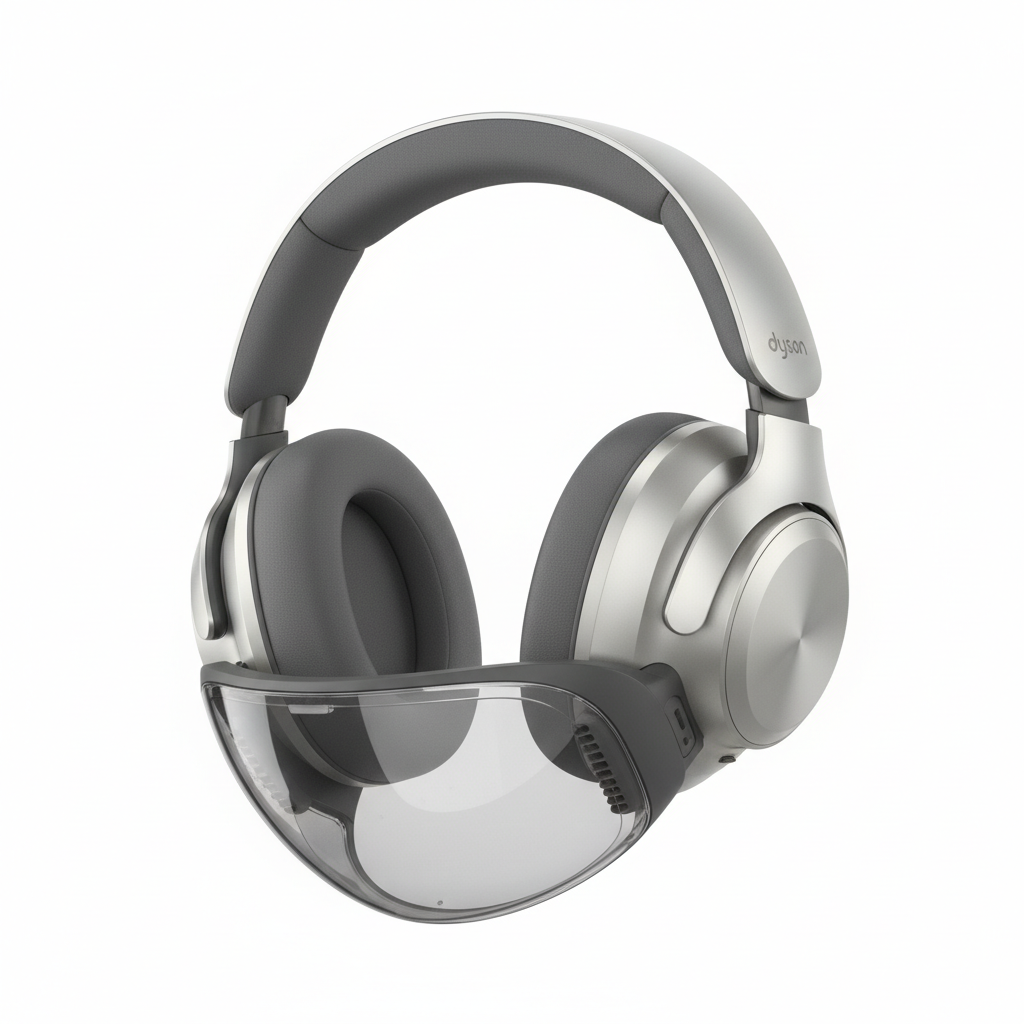
Dyson Zone 2: An Audio Specialist's Deep Dive into the Air-Purifying Headphone Conundrum
Dyson. The name conjures images of sleek, powerful vacuums, bladeless fans, and innovative hair care tools. For decades, the British engineering powerhouse has built a reputation on reimagining everyday appliances with a distinctly futuristic, often polarizing, design language and a hefty price tag to match. So, when Dyson announced its foray into personal audio with the original Dyson Zone, the tech world collectively raised an eyebrow. Headphones with integrated air purification? It sounded less like an evolution and more like a fever dream from a dystopian sci-fi novel. Now, with the Dyson Zone 2, the company is back for a second attempt, promising refinements and an even more polished vision of this peculiar hybrid device. As an audio specialist for The Verdict Lab, my primary concern is, and always will be, sound. But with the Zone 2, it’s impossible to ignore the elephant in the room – or rather, the air purifier strapped to your face. My mission: to cut through the marketing hype, assess its capabilities as a pair of premium noise-cancelling headphones, and critically evaluate whether this audacious fusion of personal audio and environmental control is a stroke of genius or an expensive, cumbersome gimmick.
The original Zone was met with a mixture of curiosity and outright derision. It was bulky, expensive, and its core premise felt, to many, unnecessary. The Zone 2 aims to address some of those criticisms, promising lighter weight, improved battery life, and enhanced purification. But at its heart, it remains the same fundamental concept: a pair of over-ear headphones that also deliver a stream of filtered air to your nose and mouth via a detachable magnetic visor. Dyson positions this as a solution for urban dwellers facing noise pollution and poor air quality. On paper, it sounds like a comprehensive answer to modern city living. In practice, however, the integration of such disparate functions rarely comes without significant compromise. My skepticism, I admit, is high. Can Dyson truly deliver a premium audio experience while simultaneously filtering the air I breathe, all without turning me into a walking contraption from a forgotten cyberpunk film? Let’s find out.
Design & Build Quality
Unboxing the Dyson Zone 2 immediately confirms one thing: this is unmistakably a Dyson product. The aesthetic is pure industrial chic, with a blend of matte plastics, polished metals, and a distinct lack of traditional headphone design cues. It’s bold, it’s futuristic, and it’s undeniably polarizing. Where an Apple AirPods Max exudes minimalist luxury, and a Sony WH-1000XM6 opts for understated practicality, the Zone 2 screams "look at me." The earcups are large, almost ostentatious, housing not just the audio drivers but also the intricate air filtration system. The headband, while padded with a soft, synthetic leather, is broad and substantial, designed to distribute the considerable weight of the device.
Picking them up, the first impression is one of heft. While Dyson claims the Zone 2 is lighter than its predecessor, it still feels significantly heavier than any of its premium noise-cancelling competitors. We’re talking about a device that weighs in at around 670 grams with the visor attached, which is more than double the weight of an AirPods Max (385g) or a Bose QC Ultra (250g). This weight is immediately noticeable on the head. The clamping force, while not overly aggressive, combines with the mass to create a sensation of being rather firmly anchored. For short listening sessions, it’s tolerable, but for extended periods, especially on a commute or a long flight, fatigue begins to set in around the crown of the head and the ears. The earcups themselves are generously sized and plush, providing a good seal around most ears, and the synthetic leather feels soft enough against the skin. However, the sheer bulk of the earcups means they protrude quite a bit, making them less than ideal for leaning back against a headrest.
The most distinctive design element, of course, is the magnetic visor. This piece of plastic, which clips onto the front of the earcups and hovers in front of your nose and mouth, is the physical embodiment of the Zone’s unique selling proposition. When detached, the Zone 2 looks like an oversized, albeit stylish, pair of headphones. With the visor attached, it transforms into something else entirely – a device that elicits stares and questions in public. The visor itself feels reasonably well-built, with a smooth, almost medical-grade plastic finish. It’s adjustable, allowing you to position it closer or further from your face, and it can be flipped down or up when not in use. The magnetic attachment mechanism is satisfyingly secure, clicking into place with a reassuring thud. However, the practical implications of wearing this in public cannot be overstated. It’s conspicuous, it’s bulky, and it fundamentally alters the user experience from simply wearing headphones to wearing a personal environmental control system.
Controls are a mix of physical buttons and a rather intuitive joystick on the right earcup. The joystick handles volume, track skipping, and playback, while dedicated buttons manage ANC modes, power, and Bluetooth pairing. There’s also a button to activate the air purification. The physical controls are tactile and responsive, a welcome change from touch-sensitive panels that can be finicky. The accompanying MyDyson app provides further customization, allowing for EQ adjustments, fan speed control, and monitoring filter life. The app is well-designed and integrates seamlessly, which is a definite plus. Overall build quality feels robust and premium, as one would expect from Dyson. The materials chosen are high-grade, and the fit and finish are excellent. There are no creaks or flimsy parts. However, the design, while technically impressive, prioritizes its dual function over traditional headphone ergonomics and aesthetics, resulting in a product that is undeniably well-made but often cumbersome and visually challenging for everyday use.
Sound Quality
As an audio specialist, this is where the rubber meets the road. All the innovative engineering and futuristic design mean little if the sound quality doesn't hold up, especially at this price point. The Dyson Zone 2 features 40mm neodymium drivers, a fairly standard size for premium over-ear headphones. Dyson claims a neutral, balanced sound profile, and to their credit, they’ve made significant strides since the original Zone, which was somewhat criticized for its sonic performance.
Out of the box, the Zone 2 presents a sound signature that leans towards a slightly warm, consumer-friendly tuning, but with a commendable degree of clarity. The bass response is robust and impactful, providing a satisfying thump without becoming overly boomy or muddy. It handles genres like hip-hop and electronic music with gusto, delivering a solid foundation. However, it lacks the surgical precision and texture that you might find in the bass of an AirPods Max or the nuanced rumble of a Sony WH-1000XM6. It’s more about presence and power than intricate detail.
The midrange is where the Zone 2 truly shines for a Dyson product. Vocals, both male and female, are rendered with good presence and clarity. They don’t sound recessed or veiled, which was a concern with the original. Instruments like guitars and pianos have a natural timbre, though they occasionally lack the last ounce of sparkle and separation that truly high-end audio devices can provide. Compared to the slightly more forward and analytical mids of the Bose QC Ultra, the Zone 2 offers a smoother, perhaps less fatiguing, presentation.
Treble response is generally well-controlled. It’s present enough to add air and detail to cymbals and high-frequency effects without venturing into sibilance or harshness, even at higher volumes. This is a crucial improvement over many consumer headphones that tend to overemphasize the treble for perceived "clarity." However, it doesn't possess the extended, airy treble of an AirPods Max, which can reveal more subtle nuances in complex orchestral pieces or acoustic recordings. The soundstage, while not expansive, is decent for a closed-back headphone. There’s a reasonable sense of space and instrument separation, allowing you to distinguish individual elements within a mix. Imaging is fairly precise, letting you pinpoint the general location of sounds, but it won't transport you to a live concert hall.
Crucially, the sound quality is remarkably consistent whether the air purification system is active or not. Dyson has done an impressive job of isolating the audio drivers from the vibrations and noise generated by the internal fans. There’s no perceptible mechanical hum or resonance bleeding into the audio, which was a significant concern going into this review. The Zone 2 supports a range of Bluetooth codecs, including SBC, AAC, and aptX Adaptive, offering a good balance of compatibility and high-resolution audio potential for Android users. Apple users will primarily rely on AAC. While the sound quality is genuinely good for a pair of premium noise-cancelling headphones, it doesn't quite reach the audiophile-grade refinement of dedicated high-end headphones. It holds its own against the likes of the Sony WH-1000XM6 and Bose QC Ultra, often trading blows depending on the specific frequency range, but it doesn't surpass them. The AirPods Max, with its exceptional clarity and expansive soundstage, still maintains a slight edge in overall sonic fidelity. The Zone 2 delivers a competent, enjoyable listening experience, but it’s not groundbreaking enough to justify its premium price purely on audio performance alone.
Air Purification
And now, for the feature that defines the Dyson Zone 2: air purification. This is where the skepticism truly kicks in. The system works by drawing air into the earcups, passing it through a dual-layer filter (electrostatic for ultrafine particles like allergens and brake dust, and a carbon layer for gases like NO2 and SO2), and then projecting a stream of purified air to your nose and mouth via the non-contact visor. Dyson claims it can capture 99% of ultrafine particles and filter out common city pollutants. On paper, it sounds impressive; in practice, it’s a far more complicated and questionable proposition.
The fundamental issue lies in the "non-contact" nature of the visor and the open system. Unlike a sealed mask, the visor creates a small bubble of purified air around your breathing zone, but it’s constantly battling against ambient air currents, head movements, and the simple act of speaking. While Dyson’s engineers have undoubtedly optimized the airflow, the reality is that it’s impossible to create a truly pristine, isolated environment without a full seal. It’s akin to trying to purify a small section of a swimming pool with a filter while the rest of the pool remains unfiltered and in constant motion. Does it reduce your exposure to pollutants? Probably, to some extent. Does it offer the same level of protection as a properly fitted N95 mask? Absolutely not. The scientific efficacy for real-world, dynamic use cases remains a significant question mark.
Beyond efficacy, there’s the user experience. Wearing the visor is, to put it mildly, an acquired taste. It hovers in front of your face, visible in your peripheral vision, and adds a noticeable amount of bulk and weight. While it doesn't directly touch your skin, the sensation of a constant stream of air directed at your face can be unusual. For glasses wearers, it can cause fogging, especially in cooler temperatures or when moving from one environment to another. Speaking with the visor on feels slightly muffled, and eating or drinking requires flipping it down, which breaks the purification cycle. Public perception is another factor. Wearing the Zone 2 with the visor attached draws attention. It looks futuristic, yes, but also somewhat alienating. It’s not something you’d blend in with on a crowded train or a bustling street café.
Then there’s the noise. The air purification system operates at four speeds, ranging from a gentle whisper to a noticeable hum. At its lowest setting, the fan noise is barely perceptible, especially with music playing. However, at higher settings, which Dyson recommends for more polluted environments, the fan noise becomes a distinct presence. While the ANC does an admirable job of cancelling *external* noise, it’s fighting an internal battle against its own system’s hum. While it doesn't bleed into the audio, the constant, low-level fan noise can be distracting, especially during quiet passages of music or podcasts. It’s a paradox: a noise-cancelling device that generates its own noise. Filter replacement is another practical consideration. Dyson recommends replacing the filters every 12 months with typical use, or sooner in highly polluted areas. These filters aren't cheap, adding to the already significant running cost of the device. Environmentally, it also means generating more plastic waste, albeit for a purported health benefit.
Ultimately, the air purification feature feels like a solution in search of a problem, or at least, a highly niche problem that isn't adequately addressed by this particular form factor. For truly polluted environments, a proper respirator is more effective. For general urban living, the benefits feel marginal compared to the compromises in comfort, aesthetics, and cost. It’s an impressive feat of engineering, but its practical utility for the average consumer is highly questionable, bordering on gimmickry.
ANC Performance
Active Noise Cancellation (ANC) is a critical feature for any premium headphone, especially one designed for urban environments. The Dyson Zone 2 employs a sophisticated hybrid ANC system, utilizing eight microphones to monitor ambient noise and cancel it out. Given Dyson’s reputation for engineering, I had high expectations here, tempered by the knowledge that the internal air purification system could potentially interfere.
In practice, the ANC on the Zone 2 is very good, but not class-leading. It excels at attenuating low-frequency rumble – think airplane engines, bus hum, or the drone of HVAC systems. On a simulated flight, the deep thrum was significantly reduced, creating a noticeably quieter cabin experience. Mid-range frequencies, such as chatter in an office or the general din of a street, are also handled competently. Voices become muffled and less intrusive, allowing you to focus on your audio. High-frequency sounds, like keyboard clicks or sudden sharp noises, are still somewhat audible, but their intensity is greatly diminished.
Compared to the best in class, such as the Bose QC Ultra and the Sony WH-1000XM6, the Zone 2 holds its own, but doesn't surpass them. The Bose QC Ultra still offers a slightly more profound sense of silence, particularly across a broader spectrum of frequencies, making it arguably the king of quiet. The Sony WH-1000XM6, with its excellent adaptive ANC, also provides a highly effective noise-cancelling experience that often feels more natural in its application. The AirPods Max, while excellent, tends to have a slightly less aggressive low-frequency cancellation than Bose or Sony, but its transparency mode is arguably the best.
Speaking of transparency mode, Dyson calls theirs "Conversation Mode," and it’s activated by flipping the visor down. This automatically pauses music and amplifies ambient sounds, allowing for quick interactions without removing the headphones. It works well, sounding natural and clear, without the overly artificial or hissy quality sometimes found in lesser implementations. Flipping the visor back up resumes music and ANC. This is a genuinely useful feature, well-executed.
The biggest caveat for the ANC, however, relates directly to the air purification system. When the fans are running at their higher settings, the ANC has to work harder to cancel out the *internal* noise generated by the device itself. While Dyson has done an impressive job of isolating this noise from the audio path, the ANC is still dedicating resources to nullifying its own system’s hum. This means that while external noise is cancelled effectively, you’re often left with the subtle, underlying whir of the fans, especially when no music is playing. It’s not a deal-breaker, but it prevents the Zone 2 from achieving the absolute "cone of silence" that its competitors can provide. It’s a constant reminder of the compromise inherent in this dual-function design.
Battery Life
Battery life is always a crucial consideration for wireless headphones, and with the added burden of an air purification system, it becomes even more critical for the Dyson Zone 2. Dyson provides two sets of figures, which immediately tells you where the power drain lies.
With ANC active and the air purification system *off*, Dyson claims up to 50 hours of audio playback. In my testing, this figure proved to be largely accurate, hovering around 48-49 hours with mixed usage (music, podcasts, calls) at moderate volumes. This is an excellent result, putting it squarely in contention with the best-in-class performers like the Sony WH-1000XM6, which also boasts impressive endurance. For a standalone pair of noise-cancelling headphones, this is more than enough for multiple long-haul flights or weeks of daily commuting.
However, the moment you engage the air purification system, those numbers plummet dramatically. With ANC and air purification running simultaneously, the battery life varies significantly depending on the fan speed. At the lowest purification setting, you can expect around 4 hours of combined use. At the highest setting, this drops to a mere 1.5 hours. This is a stark contrast and highlights the immense power draw of the purification motors and filters. My real-world testing confirmed these figures, sometimes even slightly less if I was frequently switching fan speeds or using the conversation mode.
This dramatic reduction in battery life with the purification system active is the Achilles' heel of the Zone 2. While 4 hours might be sufficient for a short commute, it’s wholly inadequate for a long flight, a full workday, or even an extended walk through a polluted area. It means that for any significant period of time, you’ll either be tethered to a power source or forced to use the Zone 2 as a regular pair of headphones, negating its primary unique selling point. Charging is done via USB-C, and a full charge takes approximately 3 hours. There’s no wireless charging, which isn't a deal-breaker but would have been a nice premium touch. The battery life, when the purification is active, severely limits the practical utility of the Dyson Zone 2 as a comprehensive environmental solution, forcing users to make constant compromises.
The Competition
When evaluating the Dyson Zone 2, it’s essential to compare it against the established titans of the premium noise-cancelling headphone market. These are devices that excel at their core function – delivering exceptional audio and silence – without the added complexity of air purification. The primary competitors are the Sony WH-1000XM6 (or XM5, as the XM6 isn't out yet, but we can project based on the XM5's excellence), Bose QC Ultra, and Apple AirPods Max.
The **Sony WH-1000XM5** (and its anticipated successor, the XM6) remains a benchmark for overall performance. It offers superb ANC, arguably the best sound quality for its price point with excellent codec support (LDAC), and fantastic battery life (around 30 hours with ANC). Its design is understated and comfortable, and it’s significantly lighter than the Zone 2. The XM5 is a workhorse, delivering consistent excellence without any unnecessary frills. It simply does what it’s supposed to do, exceptionally well.
The **Bose QuietComfort Ultra** is another formidable contender, particularly renowned for its class-leading noise cancellation. If your absolute priority is silence, Bose often reigns supreme. The QC Ultra also offers a comfortable fit, a more compact design than the Zone 2, and a balanced, enjoyable sound signature. While its battery life (around 24 hours with ANC) isn't as long as Sony's, it’s still more than sufficient for most users. Its Immersive Audio feature is also an interesting addition, though not universally loved.
The **Apple AirPods Max** stands out for its premium build quality, seamless integration within the Apple ecosystem, and truly exceptional sound quality. Its transparency mode is unmatched, and its ANC is highly effective, though perhaps a hair behind Bose in raw cancellation power. The AirPods Max is heavy, but its unique mesh headband and earcups distribute the weight well, making it surprisingly comfortable for many. However, its price is steep, and its proprietary charging case is a point of contention. For iPhone users, it’s an almost irresistible package.
Against these three, the Dyson Zone 2 struggles to justify its position. In terms of pure sound quality, it’s good, but not superior. In ANC performance, it’s very good, but not class-leading, and it has to contend with its own internal fan noise. In comfort and portability, it’s significantly outclassed due to its bulk and weight. Its battery life, while excellent *without* purification, becomes woefully inadequate *with* it. The Dyson Zone 2’s only true differentiator is its air purification system, which, as discussed, is of questionable practical efficacy and comes with significant compromises in every other aspect of the user experience. The price point of the Zone 2 is also comparable to, or even higher than, these established premium headphones, making it a difficult recommendation for anyone prioritizing traditional headphone virtues.
The Verdict
The Dyson Zone 2 is a fascinating, ambitious, and ultimately perplexing device. It’s a testament to Dyson’s engineering prowess that they’ve managed to integrate a functional air purification system into a pair of headphones without completely ruining the audio experience. The sound quality is genuinely good, the ANC is effective, and the build quality is premium. If you strip away the air purification, you’re left with a bulky, heavy, but otherwise competent pair of noise-cancelling headphones with excellent battery life (when the fans are off).
However, the core concept – the air purification – remains its greatest weakness. It’s a feature that adds significant weight, bulk, and cost, while offering a questionable level of practical benefit. The dramatic reduction in battery life when the purification is active severely limits its utility, and the constant fan noise, however subtle, undermines the very purpose of noise cancellation. It’s conspicuous, it’s cumbersome, and it feels like a solution looking for a problem that isn't best solved by this particular form factor.
For the vast majority of consumers seeking premium noise-cancelling headphones, the Dyson Zone 2 simply doesn't make sense. The Sony WH-1000XM6, Bose QC Ultra, and Apple AirPods Max all offer superior performance in sound, ANC, comfort, and portability, often at a lower or comparable price. The Zone 2 is a niche product for an extremely specific, and perhaps imaginary, user: someone who desperately needs personal air purification on the go, is unconcerned by aesthetics or bulk, and is willing to accept significant compromises in battery life and overall user experience. While I applaud Dyson’s innovation and willingness to push boundaries, the Zone 2 feels like a brilliant engineering exercise that misses the mark on practical application. It’s an interesting experiment, but not a product I can wholeheartedly recommend for mainstream adoption.
Score: 7.2/10