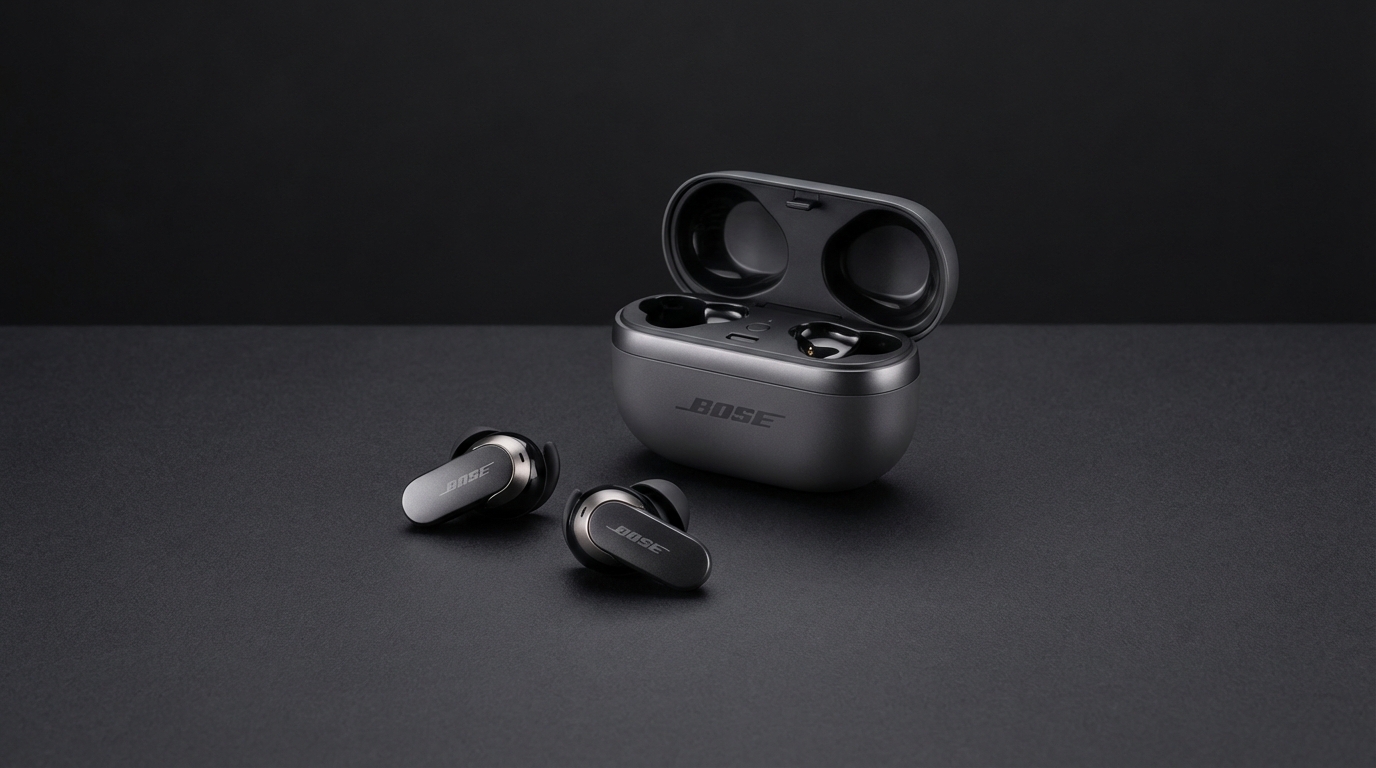
I am currently sitting in the back of a particularly rattling Uber, traversing the pothole-ridden graveyard that passes for the Brooklyn-Queens Expressway. My driver, a man named Oleg who apparently believes the car's horn is a percussion instrument, is engaged in a heated telephonic debate in a language I don't speak but whose volume transcends all linguistic barriers. Ordinarily, this would be the recipe for a tension headache. But I am currently cocooned in a bubble of artificial silence so profound it feels almost predatory. I’m wearing the Bose QuietComfort Ultra Earbuds, and for the first time in three days, I can actually hear my own thoughts without Oleg’s help.
Bose has always occupied a strange, slightly arrogant position in the audio world. They aren't the darlings of the hi-fi community—those folks prefer cables thick as garden hoses and open-back headphones that leak sound like a sieve. No, Bose is the brand for the person who just wants the world to shut up. Since the original QC earbuds landed, they’ve been the gold standard for active noise cancellation (ANC), often trading blows with Sony in a never-ending arms race of decibel destruction. With the Ultra, Bose isn’t just trying to maintain that lead; they are trying to justify a $299 price point in an era where you can get "pretty good" noise cancellation for eighty bucks at a gas station.
The "Ultra" moniker is a dangerous one. It implies a pinnacle, a ceiling, a point beyond which no further progress is necessary. In the tech world, "Ultra" usually means "we added a feature you didn't know you wanted and charged you an extra fifty dollars for it." In this case, that feature is Immersive Audio. But before we get into the psychoacoustics of spatial sound, we need to talk about the physical reality of these little plastic pebbles. Because if they don't stay in your ears, the software doesn't matter a damn bit.
Design & Build Quality
At first glance, the Bose QuietComfort Ultra Earbuds look remarkably similar to the QC Earbuds II they replaced. They haven't reinvented the wheel here; they’ve just polished it until it reflects your frustrated face. Each earbud weighs in at 6.24 grams. That’s light enough to forget they’re there after twenty minutes, but heavy enough to feel like a premium piece of kit rather than a toy. The dimensions remain relatively unchanged—roughly 1.72 x 3.05 x 2.24 cm. They still have that "lozenge" shape that sticks out of your ear slightly more than the Sony WF-1000XM5 or the sleek AirPods Pro 2, but it’s a design that works for a reason.
The build is predominantly high-quality plastic, but Bose has added a metallic treatment to the stems that gives them a more sophisticated, "executive" look. It’s a nice touch, though I found that it picks up oily fingerprints faster than a forensic investigator at a crime scene. The case, however, remains my primary point of contention. It weighs 59.8 grams and feels... fine. Just fine. For $299, I want a hinge that feels like it was engineered by a Swiss watchmaker. Instead, it’s a standard plastic flip-top that feels identical to the one on the $150 cheaper models. It’s also still vertically oriented and a bit too chunky for a slim-fit jeans pocket. If you’re wearing cargo pants, you’re golden. If you’re a fan of Italian tailoring, you’re going to have a weird bulge on your thigh that requires explanation.
The real genius of the design, and something I will defend to my dying breath, is the two-piece fit system. Most earbuds give you three sizes of silicone tips and call it a day. Bose gives you three sizes of tips and three sizes of "stability bands." These are little silicone rings that sit around the body of the bud and tuck into the fold of your outer ear (the anti-helix, for the anatomy nerds). This separation is crucial. My left ear canal is apparently shaped like a subterranean cavern, while my right is more of a narrow crevice. With the Ultra, I can use a large tip on the left and a medium on the right, while keeping the medium stability bands on both. The result is the most secure fit I’ve experienced in a non-custom earbud. I took these for a 5-mile run through a humid July morning in Manhattan, and despite the sweat levels reaching "industrial accident" proportions, the buds didn't budge once. They are rated IPX4, which means they’ll handle sweat and rain, but don't try to go swimming in them unless you enjoy expensive paperweights.
One minor nitpick: the touch controls. Bose uses a capacitive strip on the stem for volume—you slide your finger up or down. It’s better than the "pinch" gesture on the AirPods for volume control, but it’s still prone to the occasional misfire. If you’re adjusting the fit, you will almost certainly pause your music or accidentally crank the volume to ear-bleeding levels. It’s a trade-off for the lack of physical buttons, but I’d still prefer a tactile "click" for most functions. There’s something inherently frustrating about tapping a piece of plastic and waiting for a software-delayed beep to confirm you’ve actually done something.
Sound Quality & Performance
Let’s talk about the "CustomTune" technology. Every time you put these earbuds in, they play a short, sweeping chime. That chime isn't just a "welcome to Bose" jingle; it’s a sonar pulse. The earbuds use an internal microphone to measure how that sound bounces off your specific ear canal. It then recalibrates the frequency response and the noise cancellation profile to match your unique anatomy. It sounds like marketing fluff, but the difference is palpable. If you pull one bud out slightly to break the seal, you can hear the processing shift to compensate. It’s clever, invisible engineering that justifies the price tag.
The sound signature is classic Bose, but refined. Out of the box, it’s a "v-shaped" profile, meaning the bass and the treble are emphasized. It’s a crowd-pleasing sound that makes pop, hip-hop, and electronic music feel visceral. The bass is particularly impressive—it’s not the muddy, bloated thump you find in cheap "extra bass" headphones. It’s tight, controlled, and reaches surprisingly deep. I fired up Hans Zimmer’s "Why So Serious?" from *The Dark Knight* soundtrack. At the 3:26 mark, when that sub-bass kicks in, the Ultra Earbuds didn't distort; they vibrated my very soul. It’s a physical sensation that’s hard to replicate in an earbud.
The mids are where things get interesting. In previous generations, Bose tended to recess the mids a bit too much, making vocals feel distant. The Ultra brings them back to the center of the stage. Listening to Phoebe Bridgers' "Garden Song," her voice feels intimate, with the subtle breathiness and vocal fry preserved perfectly. The treble is crisp without being sibilant. I’m sensitive to "sharp" highs—the kind that makes a hi-hat sound like a needle in the eardrum—but Bose has tuned these to be smooth. You can listen for four hours straight without feeling like your ears are being sanded down.
Then there’s the elephant in the room: Immersive Audio. This is Bose’s take on spatial audio, and unlike Apple’s version, it doesn't require specific "Spatial Audio" tracks. It works on everything. It uses an onboard IMU (Inertial Measurement Unit) to track your head movement and process the sound to make it feel like it’s coming from two speakers in front of you rather than from inside your head. There are two modes: "Still" and "Motion."
In "Still" mode, the soundstage is fixed. If you turn your head to the right, the "speakers" stay in place, so the music now sounds like it's coming into your left ear. It’s uncannily realistic. I spent twenty minutes in my office turning my head back and forth like a confused owl, marveling at how the processing kept the phantom center fixed in space. "Motion" mode is designed for when you’re walking; it keeps the soundstage in front of you even as you move. Does it make the music sound better? Not necessarily. It adds a bit of artificiality and slightly thins out the low end. But does it make the listening experience more *natural*? Absolutely. It removes that "closed-in" feeling that earbuds often produce. However, it comes at a cost: it murders the battery life, and occasionally, the tracking can get "stuck," requiring a quick reset of the head position. It's a fun trick, but for critical listening, I leave it off.
As for the ANC, it remains the undisputed heavyweight champion. I’ve tested these against the Sony XM5 and the AirPods Pro 2 on a cross-country flight. The Sony buds are excellent at high-frequency hiss, but the Bose Ultras are masters of the low-frequency rumble. They managed to reduce the roar of a Boeing 737 engine by what felt like 35-40dB in the lower registers. It turns a chaotic cabin into a library. In an office setting, they delete the sound of mechanical keyboards and the distant murmur of the "synergy" meeting happening three cubicles over. It’s not just "quiet"; it’s a pressurized silence that can be a little disconcerting for first-time users. If you have "Eardrum Pressure" sensitivity, you might find the ANC a bit intense, but for me, it’s pure bliss.
Features & Software
The Bose Music app is the command center for the Ultra Earbuds, and it’s a bit of a mixed bag. On one hand, the UI is clean and the EQ is actually useful. It’s a three-band EQ (Bass, Mid, Treble) which feels a bit primitive compared to Sony’s five-band plus "Clear Bass" slider, but it gets the job done. You can create custom modes that combine different levels of noise cancellation with Immersive Audio settings. For instance, I have a "Commute" mode with max ANC and Immersive Motion, and an "Office" mode with medium ANC and no immersion.
The "Aware" mode (transparency) is still the best in the business, rivaled only by Apple. It doesn't sound like you're listening to the world through a microphone; it sounds like you aren't wearing earbuds at all. The "ActiveSense" feature is particularly clever—if a loud noise occurs while you're in Aware mode (like a jackhammer or a bus screeching to a stop), the buds will automatically ramp up the noise cancellation for that specific sound and then bring it back down once it passes. It’s a hearing-protection feature that I’ve come to rely on more than I expected.
However, the software isn't without its ghosts. I’ve experienced occasional "handshake" issues where one earbud connects and the other doesn't, requiring me to put them back in the case and try again. It happens maybe once every fifty connections, but it’s annoying enough to mention. Also, the lack of true multipoint connectivity at launch was a massive oversight for a "pro" product. Bose eventually addressed this via a firmware update, allowing you to connect to two devices simultaneously (like your phone and your laptop), but the implementation is still a bit clunkier than the seamless switching you get with the AirPods or the Technics EAH-AZ80.
For the Android crowd, the Ultra Earbuds support Snapdragon Sound and aptX Adaptive. This is a big deal if you have a compatible phone, as it allows for near-lossless audio and lower latency. If you’re an iPhone user, you’re stuck with AAC, which is fine, but you’re effectively paying for a high-end codec you can’t use. The inclusion of Google Fast Pair is a nice touch, making the initial setup on an Android device a three-second affair.
One feature that I find inexplicably missing is an "Auto-Pause" that actually works 100% of the time. The earbuds have wear sensors, but they are surprisingly finicky. Sometimes I’ll take a bud out and the music keeps playing, mocking me. Other times, I’ll just adjust the bud in my ear and the music pauses. It’s a small thing, but at $300, these small things aggregate into a general sense of "why isn't this perfect yet?"
Battery Life & Connectivity
Bose claims 6 hours of battery life with ANC on, and about 4 hours if you have Immersive Audio enabled. In my testing, these numbers are fairly accurate, perhaps even a bit conservative. On a recent trip from New York to London, I got about 5 hours and 45 minutes of straight listening with ANC at max before the "battery low" warning chimed in my ear. The case provides another three full charges, bringing the total to about 24 hours.
Let’s be honest: 6 hours is mediocre. The Sony WF-1000XM5 gives you 8 to 12 hours depending on settings. The Sennheiser Momentum True Wireless 4 can hit 7.5 hours easily. While 6 hours is enough for most commutes and even a decent-sized flight, it means you’ll be charging the case more often than you would with the competition. It’s the price you pay for the massive amount of processing power required for that industry-leading ANC and the Immersive Audio engine.
Charging is handled via USB-C. And here is where I get a little "Marcus Webb" angry: Wireless charging is not standard. To get a case that supports Qi wireless charging, you either have to buy a specific bundle or purchase a $49 silicone cover that adds the functionality. In 2024, for a flagship product labeled "Ultra," missing wireless charging is like selling a luxury car and charging extra for power windows. It’s a blatant cash grab that leaves a sour taste in my mouth. I don't care that most people don't use wireless charging daily; it’s the principle of the thing.
Connectivity is handled by Bluetooth 5.3. Range is excellent; I can leave my phone on my desk and walk to the kitchen (about 30 feet and two walls away) without a single dropout. The latency is also surprisingly low, even without using aptX Adaptive. Watching YouTube videos or Netflix shows, the lip-sync is perfect. If you're a competitive mobile gamer playing *PUBG* or *Genshin Impact*, you might notice a slight delay, but for 99% of users, it’s a non-issue.
Call quality is an area where Bose has made significant strides. Each bud has four microphones, and they do a commendable job of isolating your voice from background noise. I took a call while walking through a windy park, and the person on the other end said I sounded "clear, if a bit processed." It’s not "studio quality," but it’s significantly better than the muffled mess of the original QC Earbuds. They use a new chipset to handle wind noise reduction, and it actually works. It won't beat a dedicated boom mic, but for a pair of earbuds, it’s in the top tier.
The Competition
The high-end earbud market is a shark tank. Bose isn't just competing with sound; they’re competing with ecosystems.
First, there’s the **Sony WF-1000XM5**. Sony’s buds are smaller, have better battery life, and offer a more granular EQ. They also use foam tips as standard, which some people find more comfortable and better for passive isolation. However, Sony’s ANC, while incredible, still can’t quite match the "black hole" silence of the Bose Ultra. The Bose fit is also significantly more stable for exercise. If you’re an audiophile who wants LDAC support and 8 hours of battery, go Sony. If you’re a traveler who wants the best silence possible, stay with Bose.
**Apple’s AirPods Pro (2nd Gen)** are the obvious choice for iPhone users. The integration with iOS is unparalleled—the instant switching between iPad, Mac, and iPhone is a convenience that’s hard to give up. The AirPods Pro 2 also have a slightly more balanced, "natural" sound profile. However, the Bose Ultra Earbuds have better ANC (by a hair) and the stability bands make them much better for the gym. Also, Bose’s Immersive Audio works on any device, whereas Apple’s Spatial Audio is much more restricted to their own ecosystem and specific content.
Then there are the **Sennheiser Momentum True Wireless 4**. These are the buds for people who prioritize sound quality above all else. They support aptX Lossless and have a richness in the midrange that Bose can't quite touch. But Sennheiser’s ANC is a distant third in this race. It’s good, but it won't make a crying baby on a plane disappear. Bose is a utility tool that happens to sound great; Sennheiser is a hi-fi component that happens to have ANC.
Finally, we have the **Devialet Gemini II**. At $450, they are significantly more expensive. They sound better—wider soundstage, more texture—but their battery life is even worse than the Bose, and their ANC is hit-or-miss. They are a luxury item for people who want to stand out. The Bose Ultra, by comparison, feels like a professional tool.
The Verdict
The Bose QuietComfort Ultra Earbuds are a study in focused excellence. They don't try to be everything to everyone. They don't have the longest battery life, they don't have the most "audiophile-grade" frequency response, and the lack of standard wireless charging is a genuine annoyance that I will continue to complain about until I’m blue in the face. They are expensive, and the "Ultra" branding feels a bit like a marketing department victory rather than an engineering one.
But when you’re standing on a crowded subway platform and the screeching of the brakes is silenced so effectively that you can hear the subtle pluck of a guitar string in your music, all those complaints feel academic. The ANC here is not just an improvement; it is the benchmark. The CustomTune calibration ensures that this performance is consistent regardless of whether you have the ears of an elf or a giant. The stability and comfort provided by the fit system are, in my opinion, the best in the industry.
The addition of Immersive Audio is more than just a gimmick. While I don't use it for every track, it has changed how I listen to podcasts and live recordings. It adds a sense of "air" and space that earbuds usually lack. It makes the listening experience less fatiguing during long sessions, even if it does mean I have to plug the case in a bit more often.
If you are looking for the absolute best noise cancellation on the planet in a form factor that won't fall out of your ears while you're sprinting for a bus, these are the ones to buy. They are a premium product with a few frustrating "Bose-isms," but their core performance is so dominant that it’s easy to forgive the plastic case and the missing Qi charging. They are the best earbuds Bose has ever made, and for the moment, they are the best noise-canceling earbuds you can buy, period. Just make sure you have a USB-C cable handy.