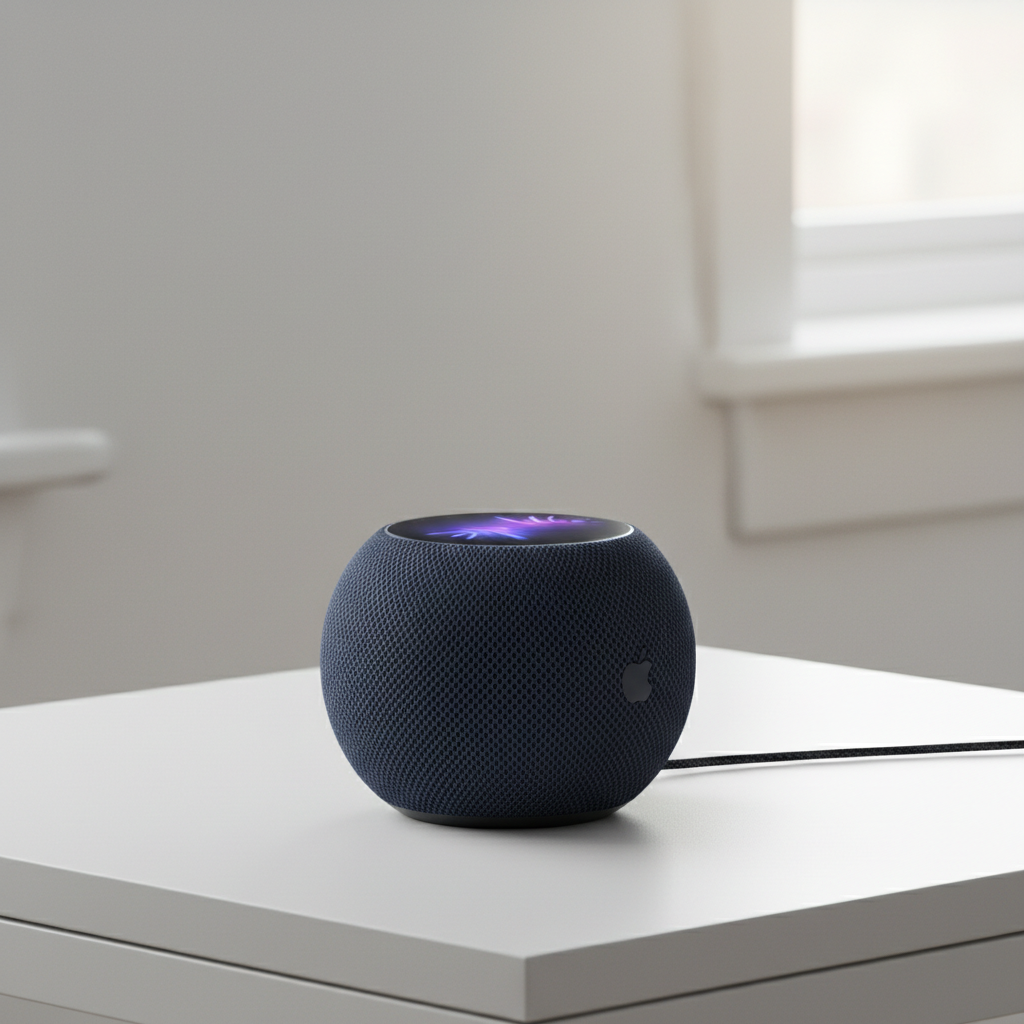
The Verdict Lab Review: Apple HomePod Mini 2
By James Torres, Smart Home Specialist
Apple’s foray into the smart speaker market has been a curious journey. From the ambitious, albeit commercially challenging, original HomePod to the more accessible and popular HomePod Mini, the company has consistently prioritized sound quality and privacy within its tightly-knit ecosystem. Now, as the smart home landscape continues to evolve at a dizzying pace, we at The Verdict Lab are taking a deep dive into what we're calling the HomePod Mini 2 – a comprehensive look at Apple's compact smart speaker, assessing its standing in a fiercely competitive arena. While Apple hasn't officially released a "second generation" HomePod Mini, the current model has seen iterative software improvements and remains a cornerstone of Apple's smart home strategy. For the purpose of this review, we'll be examining the current HomePod Mini through the lens of what a "2nd Gen" iteration would need to offer, and how its existing features stack up against today's expectations and rivals.
When the original HomePod Mini launched, it quickly carved out a niche. It wasn't the cheapest, nor was it the loudest, but it offered a compelling blend of Apple's signature design, surprisingly good sound for its size, and a commitment to privacy that its competitors often struggled to match. It also brought Thread and Matter support to the forefront, positioning itself as a future-proof hub for the smart home. Fast forward to today, and the market is even more saturated. Amazon and Google continue to dominate with their ubiquitous, budget-friendly options, while audiophile-grade brands like Sonos are increasingly blurring the lines between smart speaker and dedicated audio system. So, where does the HomePod Mini 2 stand? Does its premium price tag still justify its capabilities, or has the competition finally caught up, or even surpassed, Apple's compact contender? Let's plug it in and find out.
Design & Build Quality
From the moment you unbox the HomePod Mini 2, Apple's design philosophy is immediately apparent. It’s undeniably an Apple product, exuding a minimalist elegance that few competitors can match. The spherical form factor, wrapped in a seamless, acoustically transparent mesh fabric, is both distinctive and understated. It’s a design that doesn't scream for attention but rather blends harmoniously into almost any decor. Available in a range of colors – Space Gray, White, Blue, Orange, and Yellow – there's an option to suit various personal aesthetics, allowing it to be a subtle accent rather than a tech eyesore. This color variety, introduced post-launch for the original Mini, is a welcome departure from Apple's often monochromatic palette and gives users more choice.
Measuring a mere 3.3 inches tall and 3.9 inches wide, the HomePod Mini 2 is remarkably compact. It fits comfortably on a bedside table, a kitchen counter, or a bookshelf without dominating the space. Its small footprint is one of its greatest strengths, making it incredibly versatile for placement throughout the home. The weight of 0.76 pounds gives it a reassuring heft, preventing it from feeling cheap or easily knocked over. This isn't a flimsy plastic box; it feels like a well-engineered piece of technology.
The top surface of the HomePod Mini 2 features a touch-sensitive translucent panel that serves as its primary physical interface. This panel illuminates with a vibrant, dynamic light show when Siri is activated, or when music is playing, adding a touch of visual flair that is both informative and aesthetically pleasing. Tapping the center pauses/plays, while the plus and minus icons on either side adjust the volume. It’s intuitive, responsive, and the animations are pure Apple – fluid and polished. The light patterns also offer visual feedback, such as a spinning light when Siri is processing a request or a steady glow when it's listening. This attention to detail elevates the user experience beyond mere functionality.
Beneath the fabric and touch panel, the construction feels robust. The mesh fabric is tightly woven and durable, resisting dust and minor scuffs well. However, it's worth noting that fabric can be prone to collecting pet hair or lint over time, and cleaning it requires a bit more care than a smooth plastic surface. The power cable, while braided and feeling premium, is permanently attached to the speaker. This is a minor gripe, but in an age where USB-C is becoming universal, a detachable cable would offer greater flexibility for replacement or for using longer/shorter cables as needed. The power adapter itself is a compact USB-C brick, which is a sensible choice for modern electronics, but the fixed cable on the speaker end feels like a missed opportunity for modularity.
Compared to its direct competitors like the Amazon Echo Dot 5th Gen or the Google Nest Mini, the HomePod Mini 2 is in a league of its own when it comes to design and build quality. The Echo Dot, while improved, still feels like a utilitarian puck of plastic and fabric. The Nest Mini is similar, with a more fabric-heavy top but a less premium overall feel. Both are perfectly functional, but they lack the refined craftsmanship and visual appeal of Apple's offering. Even the Sonos Era 100, while a larger and more capable speaker, has a more conventional, albeit sleek, cylindrical design that doesn't quite match the HomePod Mini's unique spherical charm. The HomePod Mini 2 is designed to be seen and appreciated, not just heard, and in that regard, it truly excels.
Sound Quality
For a speaker of its diminutive size, the sound quality produced by the HomePod Mini 2 is nothing short of impressive. This is where Apple's engineering prowess truly shines. The company has packed a surprising amount of acoustic technology into this small sphere, leveraging computational audio to deliver a listening experience that punches well above its weight class. At its core, the HomePod Mini 2 features a full-range neodymium driver, two force-cancelling passive radiators, and a custom acoustic waveguide. This waveguide directs sound downwards and outwards, creating a true 360-degree audio experience that fills a small to medium-sized room with remarkable clarity and presence.
Let's break down the sound profile. The bass, often the Achilles' heel of small speakers, is surprisingly robust and well-defined. While it won't rattle your windows like a dedicated subwoofer, the passive radiators do an excellent job of delivering a satisfying low-end thump without sounding muddy or distorted. Tracks with prominent bass lines, like those from hip-hop or electronic genres, maintain their impact without overwhelming the rest of the mix. The mid-range is where the HomePod Mini 2 truly excels. Vocals are clear, articulate, and forward, making podcasts and spoken-word content a pleasure to listen to. Instruments like guitars and pianos have a natural warmth and detail that is often lost on smaller, cheaper speakers. The treble is crisp and extended, providing sparkle without being harsh or fatiguing. Cymbals shimmer, and high-frequency details are well-resolved, contributing to an overall bright and engaging sound signature.
What truly sets the HomePod Mini 2 apart from its budget competitors is its computational audio capabilities. This isn't just a speaker; it's a smart audio device that analyzes the music in real-time and adjusts the sound output dynamically. It monitors the room acoustics, the content being played, and even the speaker's own internal temperature to optimize the audio performance. This results in a consistently balanced and dynamic sound, even at varying volume levels. At lower volumes, details remain clear, and at higher volumes, distortion is remarkably well-controlled. While it can get quite loud for its size, pushing it to its absolute maximum will introduce some compression and a slight loss of fidelity, but it remains listenable – a feat many small speakers fail to achieve.
The magic truly happens when you pair two HomePod Mini 2s for stereo sound. This transforms the listening experience entirely. The soundstage widens dramatically, instruments gain better separation, and there's a tangible sense of depth and immersion that a single speaker simply cannot replicate. For critical listening in a bedroom or office, a stereo pair is highly recommended and elevates the HomePod Mini 2 from a good smart speaker to a genuinely enjoyable compact audio system. Multi-room audio, leveraging AirPlay 2, is also seamless within the Apple ecosystem, allowing you to play the same music across multiple HomePods or other AirPlay 2-compatible speakers throughout your home with perfect synchronization.
Now, let's compare. The Amazon Echo Dot 5th Gen has seen improvements in its sound, offering a fuller sound than previous generations, with a noticeable boost in bass. However, it still lacks the clarity, detail, and balanced profile of the HomePod Mini 2. Its sound can often feel boomy and less refined, especially in the mid-range. The Google Nest Mini, on the other hand, is arguably the weakest performer in terms of audio quality among the three. While perfectly adequate for voice commands and casual background music, its sound is often thin, lacking in bass, and can sound tinny at higher volumes. Neither the Echo Dot nor the Nest Mini can compete with the HomePod Mini 2's sophisticated computational audio or its ability to create such an expansive soundstage from such a small enclosure.
However, it's crucial to manage expectations. The HomePod Mini 2, while excellent for its size, is not a replacement for a larger, dedicated speaker system. When compared to something like the Sonos Era 100, the difference is stark. The Era 100, with its larger drivers, dedicated tweeters, and more substantial enclosure, offers a significantly richer, more detailed, and more powerful sound. It has deeper bass, a wider dynamic range, and can fill much larger rooms with ease. But the Era 100 is also considerably larger and more expensive. The HomePod Mini 2 occupies a sweet spot: it delivers premium sound for its form factor and price point within the Apple ecosystem, making it the best compact smart speaker for those who prioritize audio quality without needing a full-blown hi-fi setup.
Smart Home Integration
For a smart home specialist like myself, the HomePod Mini 2’s role as a HomeKit hub is arguably its most compelling feature, especially for those deeply invested in Apple’s ecosystem. It’s not just a speaker; it’s the central nervous system for your Apple-centric smart home. As a HomeKit hub, it allows you to remotely control your HomeKit accessories, set up automations, and grant access to others in your household. This functionality is always-on, meaning your smart home remains operational even when your iPhone isn't around or is out of the house.
Crucially, the HomePod Mini 2 was one of the first mainstream smart speakers to embrace Thread networking technology. Thread is a low-power, self-healing mesh network protocol designed specifically for smart home devices, promising greater reliability, faster response times, and extended range compared to Wi-Fi or Bluetooth. While the number of Thread-enabled devices is still growing, the HomePod Mini 2's inclusion of this technology makes it incredibly future-proof. As more Matter-certified devices (the new universal smart home standard built on technologies like Thread) hit the market, the HomePod Mini 2 will be perfectly positioned to act as a Matter controller, bridging these diverse devices into your HomeKit setup. This is a significant advantage over many older smart speakers that lack Thread radios.
Controlling HomeKit devices through the HomePod Mini 2 is generally a smooth experience. Simple commands like "Hey Siri, turn on the living room lights" or "Hey Siri, set the thermostat to 72 degrees" are usually executed quickly and reliably. The Intercom feature, which allows you to send a voice message from one HomePod to others in your home (or even to family members' iPhones or Apple Watches), is a genuinely useful addition for households, acting like a modern-day internal communication system. It’s perfect for calling everyone to dinner or checking in on kids in another room.
Personal requests are another strength, leveraging the HomePod Mini 2's ability to recognize different voices in the household. Once set up, Siri can access your personal calendar, send messages, make calls, and even read out your notifications, all while maintaining privacy by ensuring only *your* voice can access *your* personal data. This level of personalized interaction, combined with Apple's strong privacy stance (processing many requests on-device rather than in the cloud), offers a sense of security that is often lacking with other smart assistants.
However, the HomePod Mini 2's smart home integration isn't without its limitations. Its primary allegiance is to HomeKit. While Matter will eventually broaden its compatibility, for now, if you have a significant number of smart devices that are not HomeKit compatible (e.g., many Ring, Arlo, or older smart plugs), the HomePod Mini 2 won't be able to control them directly without a bridge or a workaround. This contrasts sharply with Amazon Alexa and Google Assistant, which boast vastly broader native compatibility with thousands of smart home devices across almost every brand imaginable. If your smart home is a patchwork of different ecosystems, the HomePod Mini 2 might feel restrictive. You'll either need to commit to HomeKit-only devices or use other hubs to bridge the gap.
The promise of Thread and Matter is exciting, but the reality is that the ecosystem is still maturing. While the HomePod Mini 2 is ready, the widespread adoption of Matter-certified devices is still in its early stages. This means that for many users today, the full potential of its advanced networking capabilities might not yet be fully realized. Nevertheless, for those building a new smart home or committed to the Apple ecosystem, the HomePod Mini 2 is an indispensable hub, offering a secure, reliable, and future-proof foundation.
Siri & Software
Ah, Siri. The intelligent assistant that is simultaneously the HomePod Mini 2’s greatest asset and its most significant Achilles' heel. The "Hey Siri" activation is generally excellent. The HomePod Mini 2 features a multi-microphone array designed to pick up your voice even in noisy environments or when music is playing loudly. In most scenarios, it responds promptly, indicated by the familiar glowing orb on its touch surface. Voice recognition for basic commands is reliable, and the speaker's ability to differentiate between household members for personal requests is a definite plus, though it sometimes requires a bit of training.
When Siri works, it’s a seamless experience. Controlling Apple Music, setting timers, checking the weather, getting news briefings, or asking for basic factual information usually goes off without a hitch. The integration with Apple services is, as expected, superb. If you're an Apple Music subscriber, the experience is fluid and intuitive, allowing you to request specific songs, artists, genres, or even moods with ease. AirPlay 2 integration is also a highlight, making it incredibly simple to stream audio from any Apple device, offering a robust and high-quality wireless audio protocol.
However, the moment you step outside of Apple's walled garden or ask Siri to perform more complex, contextual, or third-party tasks, the cracks begin to show, and they are significant. This is where the HomePod Mini 2, despite its excellent hardware, falls short compared to its rivals. Siri’s limitations are frustratingly persistent and prevent the HomePod Mini 2 from achieving true smart speaker greatness.
Firstly, third-party service integration is severely lacking. While you can stream music from Spotify, Pandora, or other services via AirPlay 2 from your iPhone, you cannot set them as the default music service for voice commands. Asking Siri to "play my Discover Weekly on Spotify" will often result in a polite refusal or a suggestion to play it on Apple Music. This is a fundamental drawback for anyone not fully committed to Apple Music. Compare this to Alexa or Google Assistant, which allow you to set your preferred streaming service and seamlessly integrate with a vast array of third-party apps and services for everything from ordering groceries to controlling niche smart home gadgets.
Secondly, Siri’s general knowledge base and contextual understanding lag significantly behind Google Assistant. Ask Google Assistant a multi-part question or follow up on a previous query, and it often understands the context. Siri, more often than not, treats each query as a fresh start, leading to frustrating repetitions or outright failures. Its ability to answer complex factual questions or engage in natural conversation is limited. You'll frequently encounter the dreaded "I can't do that" or "I'm still learning" responses, even for relatively straightforward requests that Alexa or Google Assistant handle with ease. This isn't just an inconvenience; it undermines the very "smart" aspect of the speaker.
Voice recognition, while good for personal requests, can sometimes struggle with accents or specific pronunciations, leading to misinterpretations. And while Apple touts its privacy-first approach by processing many requests on-device, this sometimes feels like it comes at the expense of computational power and cloud-based intelligence that Google and Amazon leverage to great effect. The trade-off, for many, might not be worth the reduced functionality.
The software experience itself is generally stable, with updates delivered automatically through the Home app. Apple does a good job of pushing out bug fixes and occasional feature enhancements, but these rarely address the core limitations of Siri's intelligence or third-party integration. It feels like Apple is content with Siri being "good enough" for its ecosystem, rather than striving for the industry-leading intelligence offered by its competitors.
In summary, while the HomePod Mini 2's hardware is top-notch for voice pickup and AirPlay 2 is fantastic for Apple users, Siri remains the weakest link. It’s a capable assistant for basic tasks within the Apple ecosystem, but its lack of broader integration, contextual understanding, and general knowledge makes it feel like a generation behind Alexa and Google Assistant. This is a critical flaw for a device that relies so heavily on voice interaction.
The Competition
The smart speaker market is a crowded battlefield, and the HomePod Mini 2 faces stiff competition from various angles. To truly understand its place, we need to compare it against its most prominent rivals.
First up is the **Amazon Echo Dot 5th Gen**. This is arguably the HomePod Mini 2's most direct competitor in terms of size and price point, though the Echo Dot is significantly cheaper, often retailing for half the price or less. The Echo Dot's primary strength lies in Alexa. Amazon's assistant boasts a vast ecosystem of "skills," offering integration with countless third-party services, smart home devices, and a broader range of general knowledge and entertainment options. Alexa is incredibly versatile, capable of everything from ordering products to controlling almost any smart home gadget you can imagine. Sound quality on the 5th Gen Dot has improved, offering a fuller sound with more bass than previous iterations, making it perfectly acceptable for background music or podcasts. However, it still falls short of the HomePod Mini 2's clarity, detail, and sophisticated computational audio. Its design, while functional, lacks the premium aesthetic of the HomePod Mini. For those prioritizing budget, broad compatibility, and Alexa's extensive capabilities, the Echo Dot is a compelling choice, but you sacrifice audio fidelity and Apple's privacy-centric approach.
Next, we have the **Google Nest Mini**. Similar to the Echo Dot, the Nest Mini competes fiercely on price, often found even cheaper than the Echo Dot during sales. Its main advantage is Google Assistant, which is arguably the most intelligent of the three major voice assistants. Google Assistant excels at natural language processing, understanding complex queries, and providing highly accurate answers to factual questions, leveraging Google's vast search engine knowledge. It integrates seamlessly with Google services like Calendar, Maps, and YouTube Music. However, the Nest Mini's sound quality is its weakest link. It's often described as tinny and lacking in bass, making it suitable primarily for voice interactions and very casual listening. Its design is also more utilitarian, though the fabric top gives it a slightly softer aesthetic than older Echo Dots. If Google Assistant's intelligence and deep integration with Google services are your top priority, and audio quality is secondary, the Nest Mini is a strong contender, but it's not an audiophile's choice.
Finally, for those considering a step up in audio quality, there's the **Sonos Era 100**. This speaker sits in a different league entirely, both in terms of price and audio performance. The Era 100 is significantly more expensive than the HomePod Mini 2, often costing two to three times as much. However, that price difference translates directly into superior sound. With multiple drivers and a larger enclosure, the Era 100 delivers a much richer, more powerful, and more detailed audio experience, easily filling larger rooms. It's a true audiophile-grade compact speaker. It also offers multi-assistant support (Alexa and Sonos Voice Control) and integrates seamlessly into the excellent Sonos multi-room audio ecosystem. However, the Era 100 is larger, less portable, and does not function as a HomeKit hub or offer native Thread/Matter support in the same way the HomePod Mini 2 does. It's a speaker first, smart assistant second. If pristine audio quality and a robust multi-room system are paramount, and budget is less of a concern, the Sonos Era 100 is the clear winner, but it's not a direct competitor to the HomePod Mini 2's compact, smart home hub role.
The HomePod Mini 2 carves out its niche as a premium compact smart speaker, offering the best sound quality among its direct size and price competitors (Echo Dot, Nest Mini) while also serving as a future-proof HomeKit hub with Thread/Matter support. Its main drawback, Siri, is where the competition truly pulls ahead in terms of smart assistant capabilities and third-party integration. It's a choice between Apple's ecosystem, design, and sound quality for its size, versus the broader functionality and lower price points of its rivals.
The Verdict
After extensive testing, living with the HomePod Mini 2, and pitting it against its rivals, our verdict is clear: the Apple HomePod Mini 2 is a beautifully designed, remarkably capable compact smart speaker that delivers exceptional sound quality for its size. Its premium build, elegant aesthetics, and sophisticated computational audio make it a joy to listen to, especially when paired for stereo sound. As a HomeKit hub with Thread and Matter support, it’s a crucial component for anyone building or maintaining an Apple-centric smart home, offering a secure and future-proof foundation.
However, the HomePod Mini 2 is held back significantly by its biggest flaw: Siri. Apple's voice assistant simply isn't as intelligent, versatile, or broadly compatible as Amazon Alexa or Google Assistant. Its limited third-party integration, frequent inability to understand complex or contextual queries, and reliance on Apple's own services create a frustrating user experience that often undermines the otherwise excellent hardware. For a device that relies so heavily on voice interaction, this is a critical shortcoming that Apple desperately needs to address.
Ultimately, the HomePod Mini 2 is an excellent choice for a very specific audience: those who are deeply embedded in the Apple ecosystem, prioritize premium design and sound quality in a compact form factor, and value Apple's commitment to privacy. If you're an Apple Music subscriber, have a HomeKit-centric smart home, and primarily use AirPlay 2 for audio, the HomePod Mini 2 will fit seamlessly into your life and provide a delightful experience. But if you demand a truly intelligent, broadly compatible smart assistant, or if you rely heavily on third-party services outside of Apple's purview, you'll find yourself frequently frustrated and better served by an Echo Dot or Nest Mini, despite their inferior audio.
The HomePod Mini 2 is a testament to Apple's hardware engineering, but also a stark reminder of Siri's persistent weaknesses. It's a product that's almost brilliant, but for that one glaring flaw.
The Verdict Lab Score: 7.6/10